
Every state has an official bird, and most of them visit backyard feeders. Here is each state's bird, alphabetically by state. The northern cardinal is the bird of seven states, the western meadowlark of six and the northern mockingbird of five.
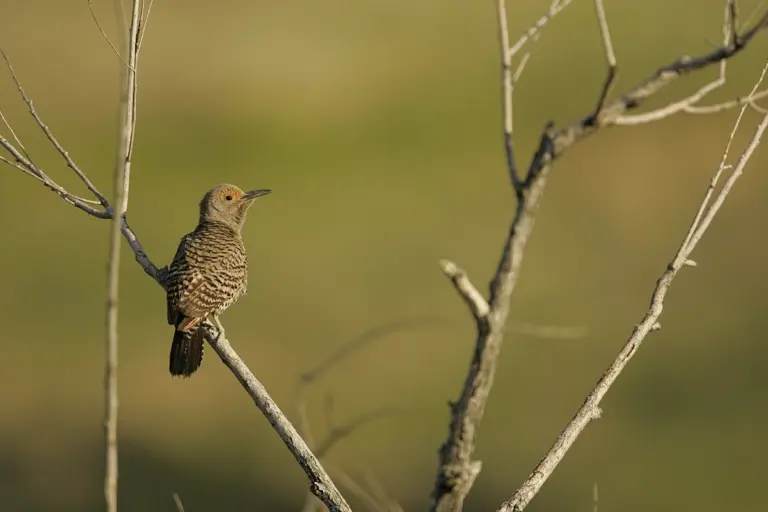
Alabama · Yellowhammer
The northern flicker or common flicker is a medium-sized bird of the woodpecker family. It is native to most of North America, parts of Central America, Cuba, and the Cayman Islands, and is one of the few woodpecker species that migrate. Over 100 common names for the northern flicker are known, including yellowhammer, clape, gaffer woodpecker, harry-wicket, heigh-ho, wake-up, walk-up, wick-up, yarrup, and gawker bird. Many of these names derive from attempts to imitate some of its calls.
Alabama is the Yellowhammer State, a nickname from Civil War soldiers whose uniforms had yellow trim. The northern flicker is a woodpecker that often feeds on the ground, eating ants; watch for the yellow under its wings in flight.
State bird of Alabama since 1927.
From Wikipedia: Northern flicker (CC BY-SA 4.0)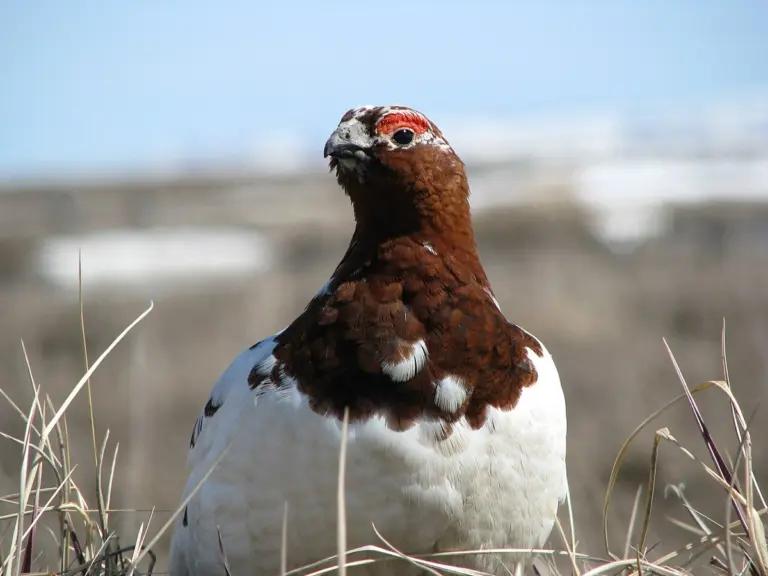
Alaska · Willow Ptarmigan
The willow ptarmigan is a bird in the grouse tribe Tetraonini of the pheasant family Phasianidae. It is also known as the willow grouse. The willow ptarmigan breeds in birch and other forests and moorlands in northern Europe, the tundra of Scandinavia, Siberia, Alaska, and Canada, in particular in the provinces of Newfoundland and Labrador and Quebec. It is the state bird of Alaska.
A grouse of the tundra that turns pure white in winter and mottled brown in summer, so it blends in all year. Feathered feet work like snowshoes.
State bird of Alaska since 1955.
From Wikipedia: Willow ptarmigan (CC BY-SA 4.0)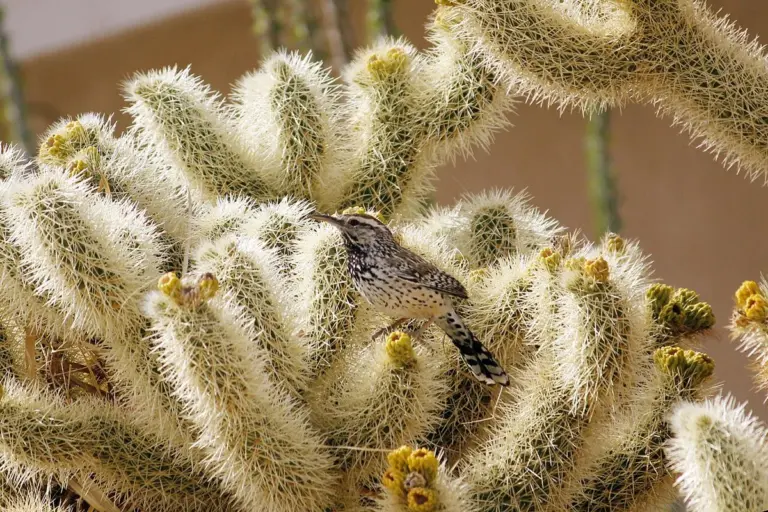
Arizona · Cactus Wren
The cactus wren is a species of wren that is endemic to the deserts of the southwestern United States and northern and central Mexico. It is the state bird of Arizona, and the largest wren in the United States. Its plumage is brown, with black and white spots as markings. It has a distinctive white eyebrow that sweeps to the nape of the neck. The chest is white, whereas the underparts are cinnamon-buff colored.
The largest wren in the United States builds football-shaped nests in cholla and other spiny cactus. Its harsh, chugging song is a classic desert sound.
State bird of Arizona since 1931.
From Wikipedia: Cactus wren (CC BY-SA 4.0)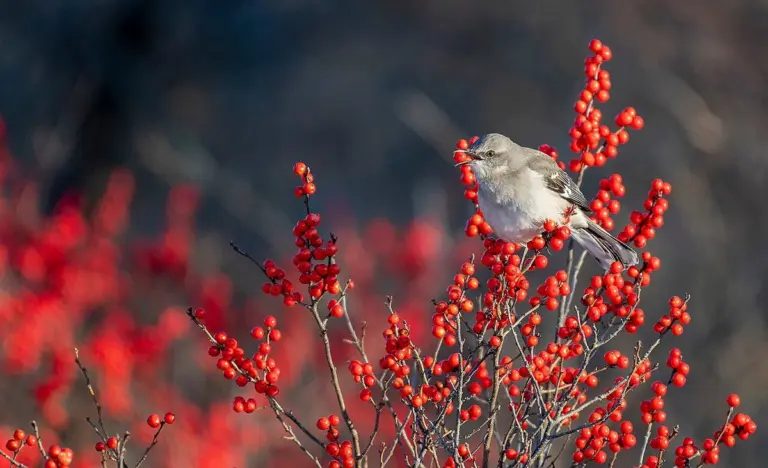
Arkansas · Northern Mockingbird
The northern mockingbird is a mockingbird commonly found in North America, of the family Mimidae. The species is also found in some parts of the Caribbean, as well as on the Hawaiian Islands. It is typically a permanent resident across much of its range, but northern mockingbirds may move farther south during inclement weather or prior to the onset of winter. The northern mockingbird has gray to brown upper feathers and a paler belly. Its tail and wings have white patches which are visible in flight.
A gray songbird famous for copying other birds' songs, and even car alarms; one male can know a couple hundred tunes. White wing patches flash when it flies.
State bird of Arkansas since 1929.
From Wikipedia: Northern mockingbird (CC BY-SA 4.0)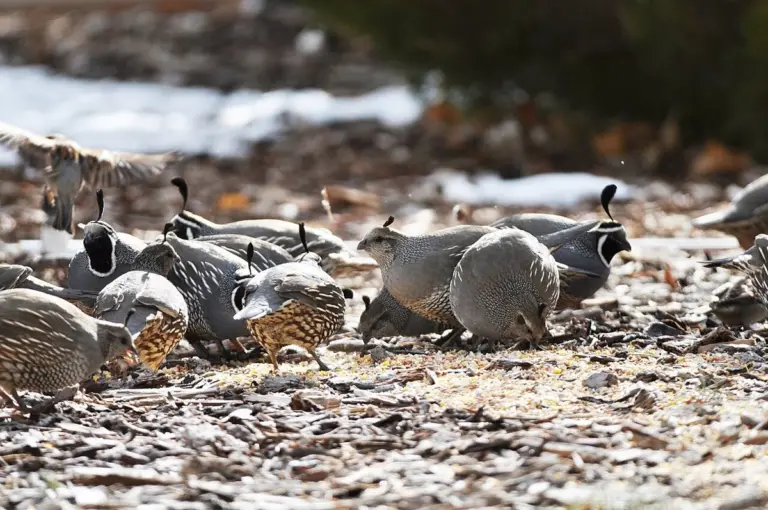
California · California Quail
The California quail, also known as the California valley quail or Valley quail, is a small ground-dwelling bird in the New World quail family, inhabiting western North America. It is the state bird of California.
A plump ground bird with a forward-curling black topknot, usually seen in groups under shrubs. Its call sounds like chi-CA-go.
State bird of California since 1931.
From Wikipedia: California quail (CC BY-SA 4.0)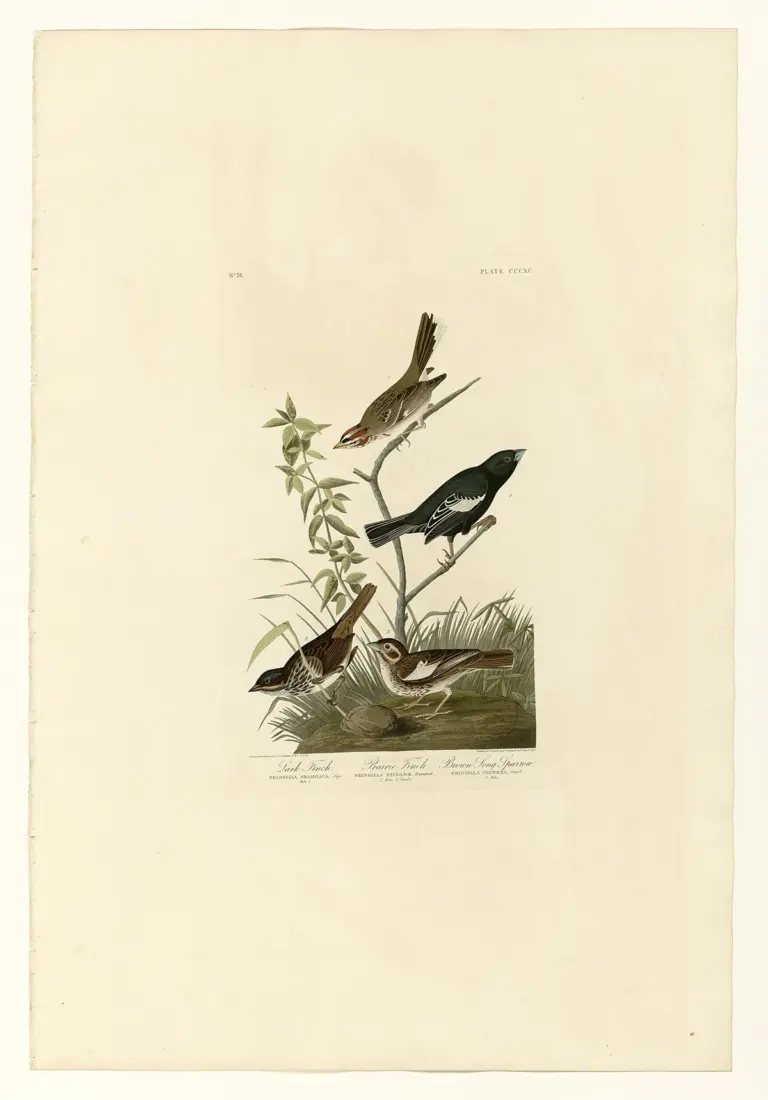
Colorado · Lark Bunting
The lark bunting is a medium-sized American bunting native to central and western North America. It was designated the state bird of Colorado in 1931.
A sparrow of the high plains. Breeding males are black with bold white wing patches and sing while fluttering up from the grass; females are streaky brown. (Picture: Audubon's "Prairie Finch", the middle bird.)
State bird of Colorado since 1931.
From Wikipedia: Lark bunting (CC BY-SA 4.0)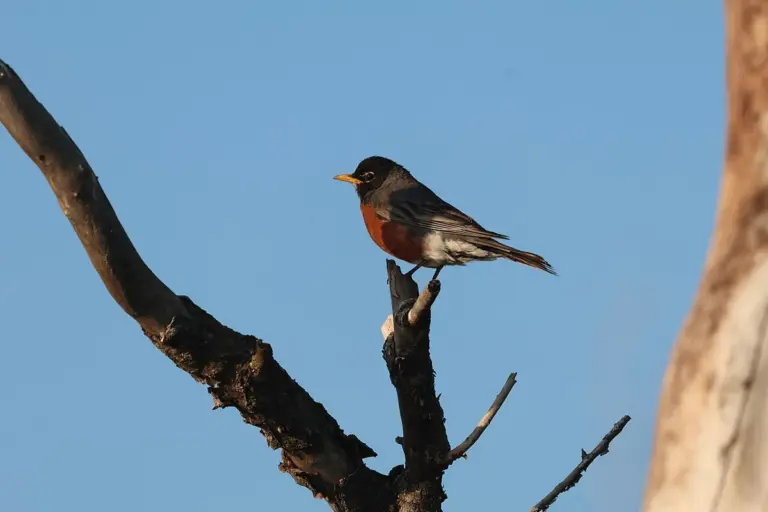
Connecticut · American Robin
The American robin is a migratory bird of the true thrush genus and Turdidae, the wider thrush family. It is named after the European robin because of its reddish-orange breast, though the two species are not closely related, with the European robin belonging to the Old World flycatcher family. The American robin is widely distributed throughout North America, wintering from southern Canada to central Mexico and along the Pacific coast.
One of the most familiar backyard birds, with a brick-red breast, often seen tugging earthworms from a lawn. Its cheerful caroling is a sure sign of spring.
State bird of Connecticut since 1943.
From Wikipedia: American robin (CC BY-SA 4.0)
Delaware · Blue Hen chicken
The Delaware Blue Hen or Blue Hen of Delaware is a blue strain of American gamecock. Under the name Blue Hen Chicken it is the official bird of the State of Delaware. It is the emblem or mascot of several institutions in the state, among them the sports teams of the University of Delaware.
Delaware's bird is a chicken, not a wild bird. In the Revolutionary War, Delaware soldiers carried fighting gamecocks of a blue-gray strain and became known as the Blue Hen's Chickens.
State bird of Delaware since 1939.
From Wikipedia: Delaware Blue Hen (CC BY-SA 4.0)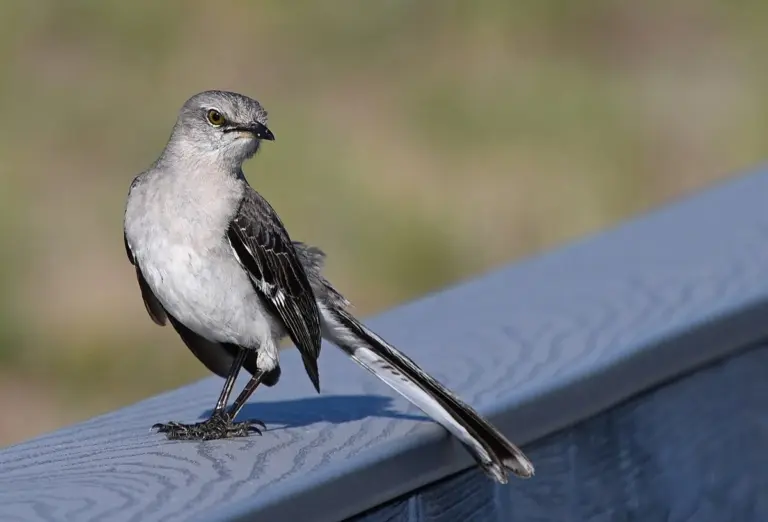
Florida · Northern Mockingbird
The northern mockingbird is a mockingbird commonly found in North America, of the family Mimidae. The species is also found in some parts of the Caribbean, as well as on the Hawaiian Islands. It is typically a permanent resident across much of its range, but northern mockingbirds may move farther south during inclement weather or prior to the onset of winter. The northern mockingbird has gray to brown upper feathers and a paler belly. Its tail and wings have white patches which are visible in flight.
A gray songbird famous for copying other birds' songs, and even car alarms; one male can know a couple hundred tunes. White wing patches flash when it flies.
State bird of Florida since 1927.
From Wikipedia: Northern mockingbird (CC BY-SA 4.0)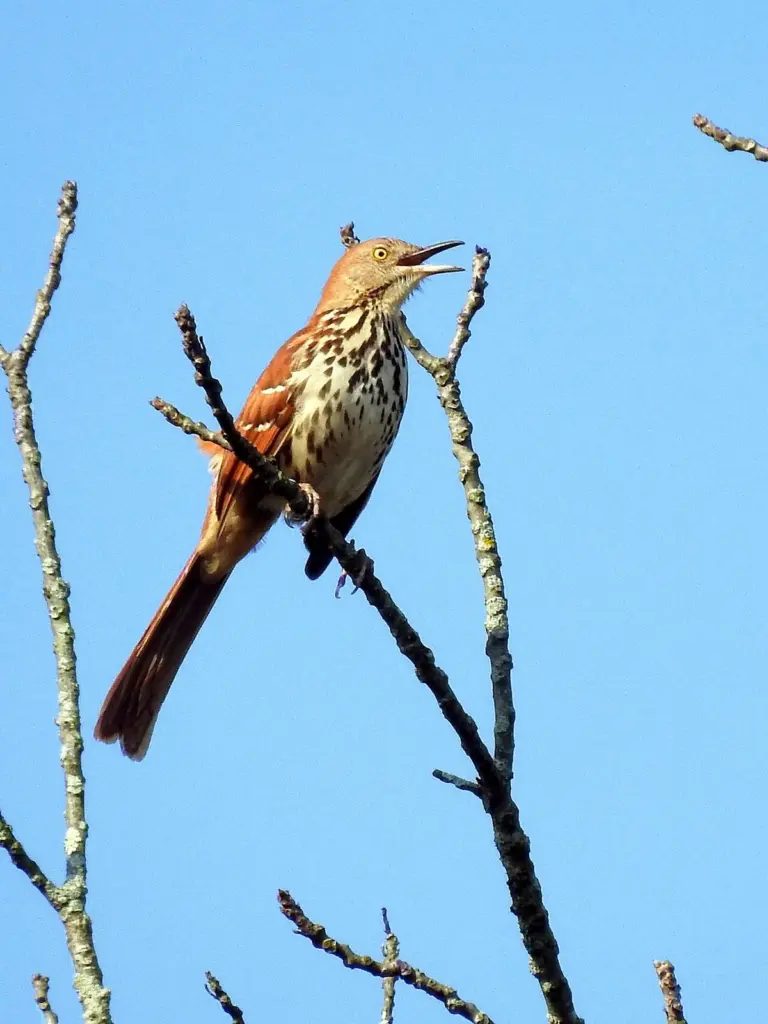
Georgia · Brown Thrasher
The brown thrasher, sometimes erroneously called the brown thrush or fox-coloured thrush, is a bird in the family Mimidae, which also includes the New World catbirds and mockingbirds. The brown thrasher is abundant throughout the eastern and central United States and southern and central Canada, and it is the only thrasher to live primarily east of the Rockies and central Texas. It is the state bird of Georgia.
A long-tailed, rusty-brown bird with a streaked chest and yellow eyes. It rummages in fallen leaves and sings long songs that repeat each phrase twice.
State bird of Georgia since 1928.
From Wikipedia: Brown thrasher (CC BY-SA 4.0)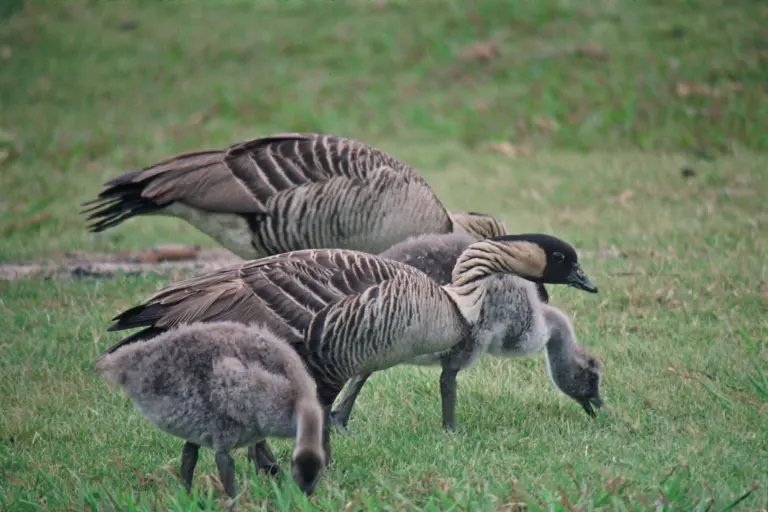
Hawaii · Nene (Hawaiian goose)
The nene, also known as the nēnē or the Hawaiian goose, is a species of bird endemic to the Hawaiian Islands. The nene is exclusively found in the wild on the islands of Maui, Kauaʻi, Molokaʻi, and Hawaiʻi. In 1957, it was designated as the official state bird of the state of Hawaiʻi.
The Hawaiian goose lives only in Hawaii and nearly died out in the 1950s; captive breeding brought it back. Its partly webbed feet suit walking on lava fields.
State bird of Hawaii since 1957.
From Wikipedia: Nene (bird) (CC BY-SA 4.0)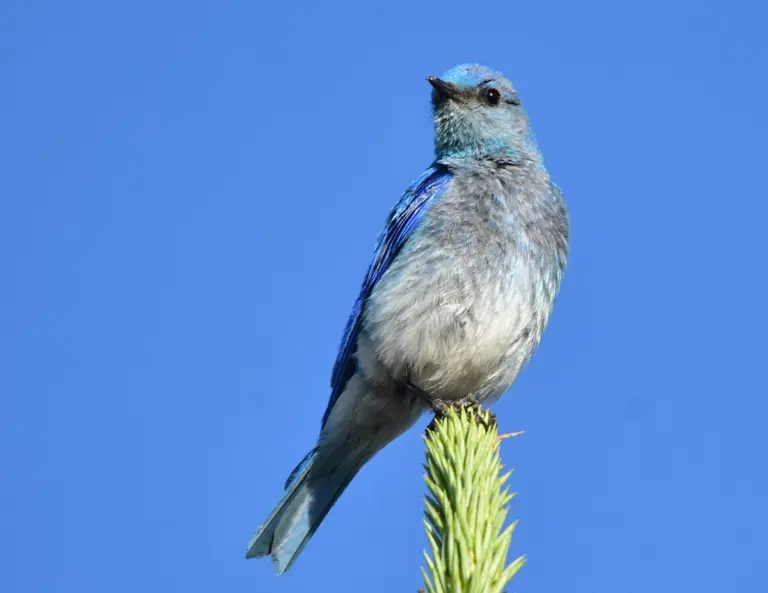
Idaho · Mountain Bluebird
The mountain bluebird is a migratory small thrush that is found in mountainous districts of western North America. It has a light underbelly and black eyes. Adult males have thin bills and are bright turquoise-blue and somewhat lighter underneath. Adult females have duller blue wings and tail, grey breast, grey crown, throat and back. In fresh fall plumage, the female's throat and breast are tinged with red-orange which is brownish near the flank, contrasting with white tail underparts.
Males are sky blue all over; females are gray with blue wings. It nests in tree holes and nest boxes in open mountain country.
State bird of Idaho since 1931.
From Wikipedia: Mountain bluebird (CC BY-SA 4.0)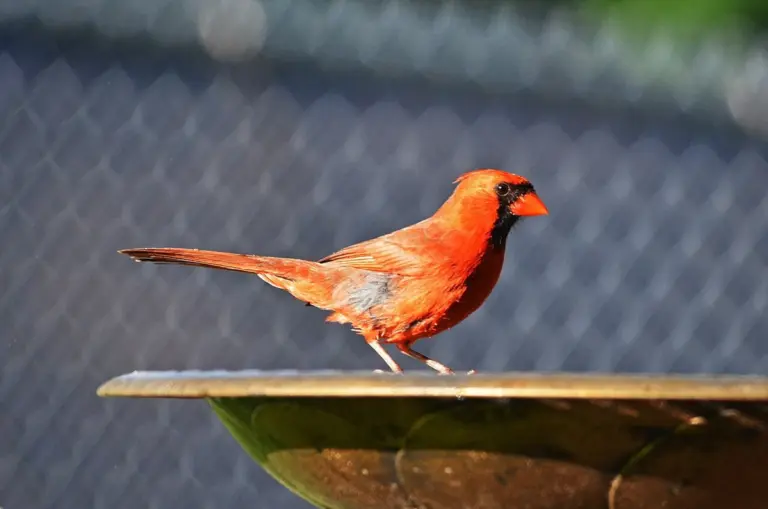
Illinois · Northern Cardinal
The northern cardinal, also commonly known as the common cardinal, red cardinal, or simply cardinal, is a bird in the genus Cardinalis. It can be found in southeastern Canada, through the eastern United States from Maine to Minnesota to Texas, New Mexico, southern Arizona, southern California and south through Mexico, Belize, and Guatemala. It is also an introduced species in a few locations such as Bermuda and all major islands of Hawaii since its introduction in 1929. Its habitat includes woodlands, gardens, shrublands, and wetlands. It is the state bird of Illinois, Indiana, Kentucky, North Carolina, Ohio, Virginia, and West Virginia.
The bright red male with its black face and pointed crest is easy to spot, especially against snow. Cardinals stay all year and come readily to sunflower seed.
State bird of Illinois since 1929.
From Wikipedia: Northern cardinal (CC BY-SA 4.0)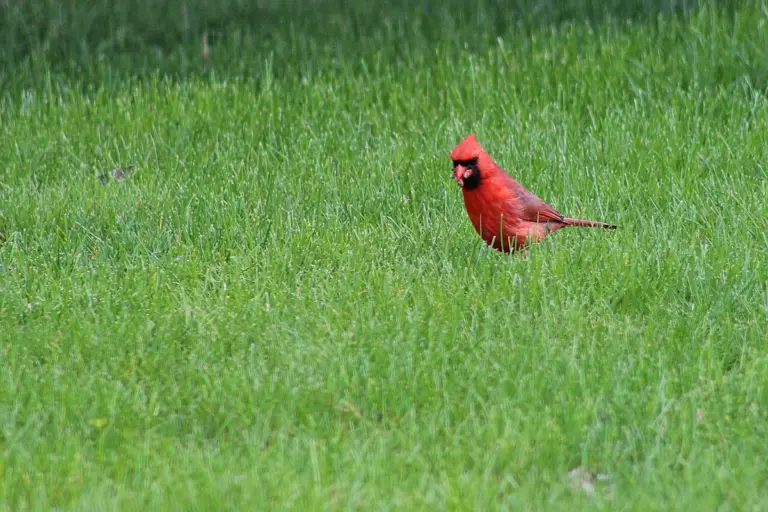
Indiana · Northern Cardinal
The northern cardinal, also commonly known as the common cardinal, red cardinal, or simply cardinal, is a bird in the genus Cardinalis. It can be found in southeastern Canada, through the eastern United States from Maine to Minnesota to Texas, New Mexico, southern Arizona, southern California and south through Mexico, Belize, and Guatemala. It is also an introduced species in a few locations such as Bermuda and all major islands of Hawaii since its introduction in 1929. Its habitat includes woodlands, gardens, shrublands, and wetlands. It is the state bird of Illinois, Indiana, Kentucky, North Carolina, Ohio, Virginia, and West Virginia.
The bright red male with its black face and pointed crest is easy to spot, especially against snow. Cardinals stay all year and come readily to sunflower seed.
State bird of Indiana since 1933.
From Wikipedia: Northern cardinal (CC BY-SA 4.0)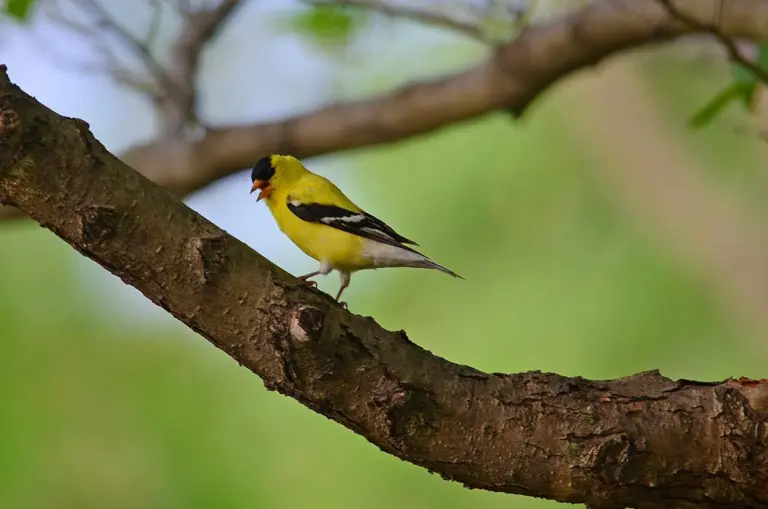
Iowa · Eastern Goldfinch
The American goldfinch is a small North American bird in the finch family. It is migratory, ranging from mid-Alberta to North Carolina during the breeding season, and from just south of the Canada–United States border to Mexico during the winter.
In summer the male is lemon yellow with black wings and cap; in winter both turn olive-brown. Goldfinches nest late in summer, when thistle seed is ripe.
State bird of Iowa since 1933.
From Wikipedia: American goldfinch (CC BY-SA 4.0)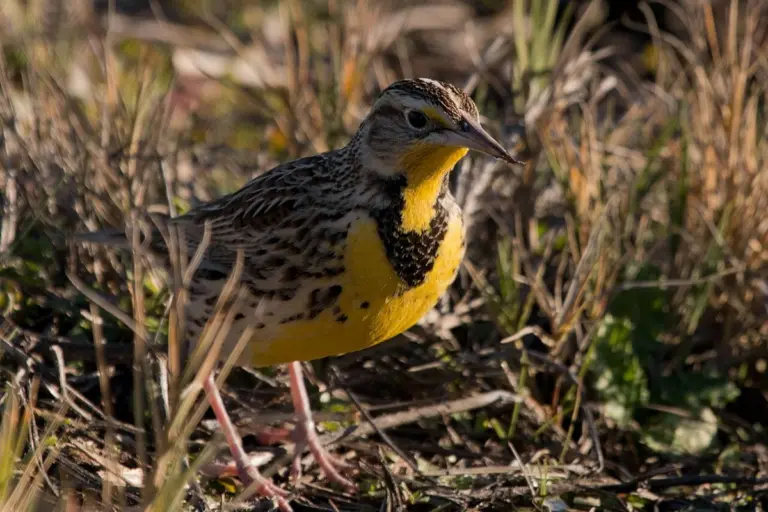
Kansas · Western Meadowlark
The western meadowlark is a medium-sized icterid bird, about 20 cm (7.9 in) in length. It is found across western and central North America and is a partial migrant, breeding in western Canada and western United States west of the Great Lakes, and in northern Mexico. In the northern half of the breeding range, the birds migrate south for the winter, while further south they are resident all year. The winter range also extends south and southeast of the breeding range, as far as central Mexico, and east to western Florida. The western meadowlark nests on the ground in open grasslands and shrublands.
A chunky grassland bird with a yellow breast and a black V, often singing its flute-like song from a fence post.
State bird of Kansas since 1933.
From Wikipedia: Western meadowlark (CC BY-SA 4.0)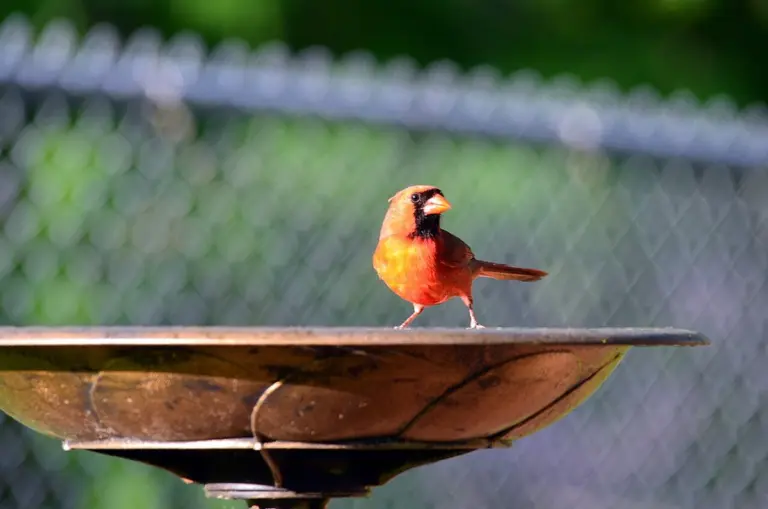
Kentucky · Northern Cardinal
The northern cardinal, also commonly known as the common cardinal, red cardinal, or simply cardinal, is a bird in the genus Cardinalis. It can be found in southeastern Canada, through the eastern United States from Maine to Minnesota to Texas, New Mexico, southern Arizona, southern California and south through Mexico, Belize, and Guatemala. It is also an introduced species in a few locations such as Bermuda and all major islands of Hawaii since its introduction in 1929. Its habitat includes woodlands, gardens, shrublands, and wetlands. It is the state bird of Illinois, Indiana, Kentucky, North Carolina, Ohio, Virginia, and West Virginia.
The bright red male with its black face and pointed crest is easy to spot, especially against snow. Cardinals stay all year and come readily to sunflower seed. Kentucky was the first state to name a state bird.
State bird of Kentucky since 1926.
From Wikipedia: Northern cardinal (CC BY-SA 4.0)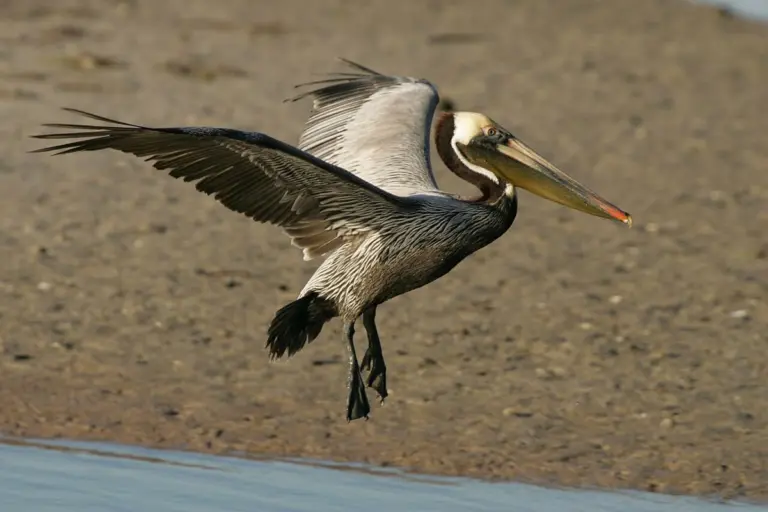
Louisiana · Brown Pelican
The brown pelican is a bird of the pelican family, Pelecanidae, one of three species found in the Americas and one of two that feed by diving into water. It is found on the Atlantic Coast from New Jersey to the mouth of the Amazon River, and along the Pacific Coast from British Columbia to Peru, including the Galapagos Islands. The nominate subspecies in its breeding plumage has a white head with a yellowish wash on the crown. The nape and neck are dark maroon–brown. The upper sides of the neck have white lines along the base of the gular pouch, and the lower fore neck has a pale yellowish patch.
The brown pelican is on Louisiana's flag and seal. It dives headfirst from the air to catch fish, and it came back from near disappearance in the state after the pesticide DDT was banned.
State bird of Louisiana since 1966.
From Wikipedia: Brown pelican (CC BY-SA 4.0)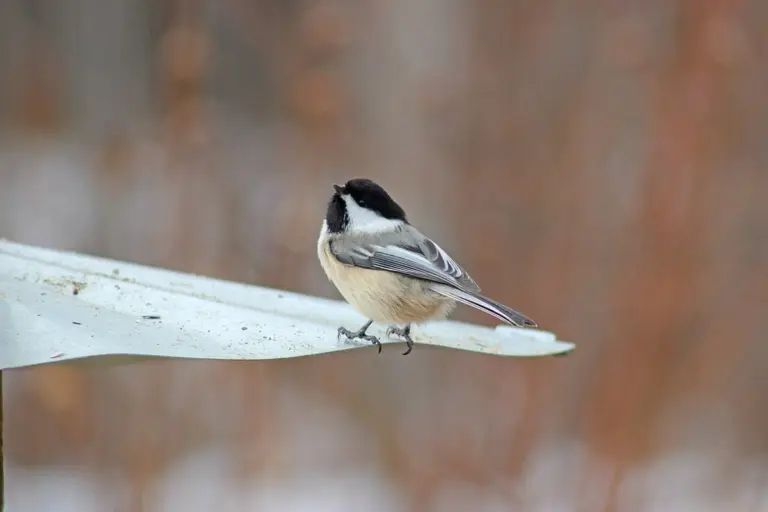
Maine · Black-capped Chickadee
The black-capped chickadee is a small, nonmigratory, North American passerine bird that lives in deciduous and mixed forests. It is a member of the Paridae family, also known as tits. It has a distinct black cap on its head, a black bib underneath, and white cheeks. It has a white belly, buff sides, and grey wings, back, and tail. The bird is well known for its vocalizations, including its fee-bee song and its chick-a-dee-dee-dee call, from which it derives its name.
A tiny, tame bird with a black cap and bib that calls its own name: chick-a-dee-dee-dee. It stays all winter and hides seeds to eat later.
State bird of Maine since 1927.
From Wikipedia: Black-capped chickadee (CC BY-SA 4.0)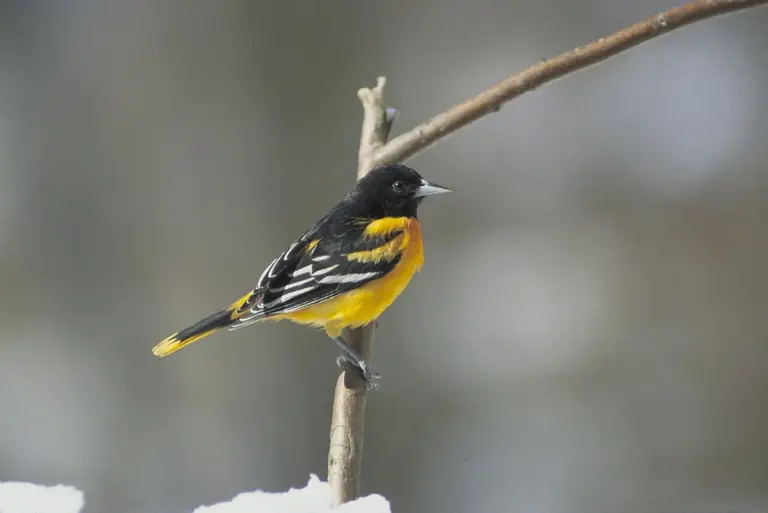
Maryland · Baltimore Oriole
The Baltimore oriole is a small icterid blackbird common in eastern North America as a migratory breeding bird. It received its common name from the resemblance of the male's colors to those on the coat-of-arms of 17th-century Lord Baltimore. Observations of interbreeding between the Baltimore oriole and the western Bullock's oriole Icterus bullockii, led to both being classified as a single species, called the northern oriole, from 1973 to 1995. Research by James Rising, a professor of zoology at the University of Toronto, and others showed that the two birds actually did not interbreed significantly.
The male's orange and black match the colors of Lord Baltimore's coat of arms. Orioles weave hanging, sock-like nests and love orange halves and grape jelly.
State bird of Maryland since 1947.
From Wikipedia: Baltimore oriole (CC BY-SA 4.0)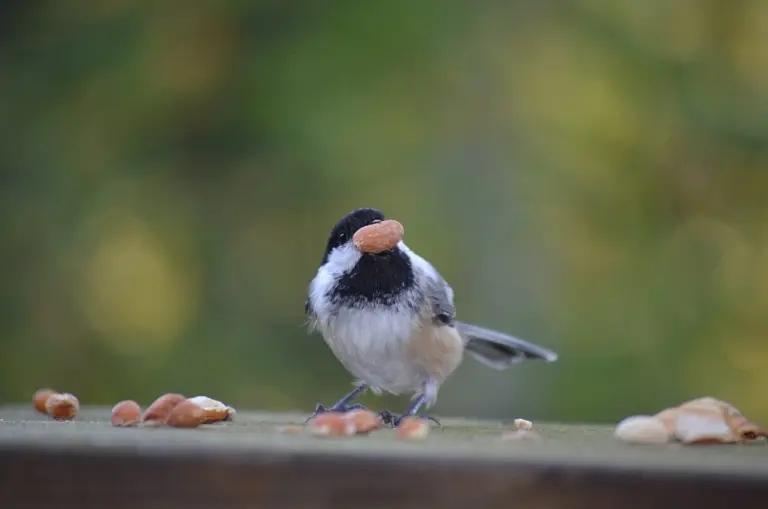
Massachusetts · Black-capped Chickadee
The black-capped chickadee is a small, nonmigratory, North American passerine bird that lives in deciduous and mixed forests. It is a member of the Paridae family, also known as tits. It has a distinct black cap on its head, a black bib underneath, and white cheeks. It has a white belly, buff sides, and grey wings, back, and tail. The bird is well known for its vocalizations, including its fee-bee song and its chick-a-dee-dee-dee call, from which it derives its name.
A tiny, tame bird with a black cap and bib that calls its own name: chick-a-dee-dee-dee. It stays all winter and hides seeds to eat later.
State bird of Massachusetts since 1941.
From Wikipedia: Black-capped chickadee (CC BY-SA 4.0)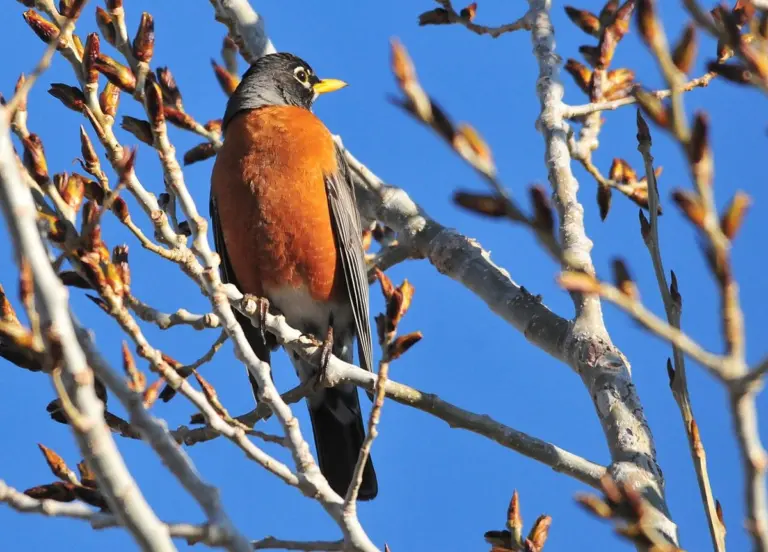
Michigan · American Robin
The American robin is a migratory bird of the true thrush genus and Turdidae, the wider thrush family. It is named after the European robin because of its reddish-orange breast, though the two species are not closely related, with the European robin belonging to the Old World flycatcher family. The American robin is widely distributed throughout North America, wintering from southern Canada to central Mexico and along the Pacific coast.
One of the most familiar backyard birds, with a brick-red breast, often seen tugging earthworms from a lawn. Its cheerful caroling is a sure sign of spring.
State bird of Michigan since 1931.
From Wikipedia: American robin (CC BY-SA 4.0)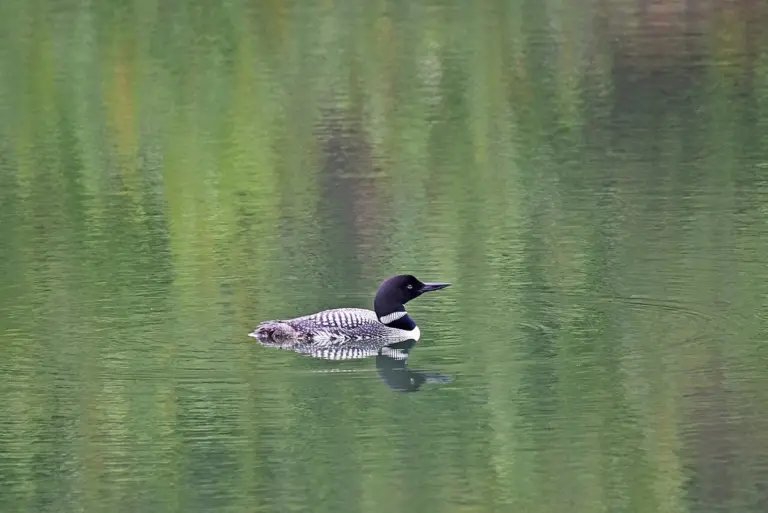
Minnesota · Common Loon
The common loon or great northern diver is a large member of the loon, or diver, family of birds. Breeding adults have a plumage that includes a broad black head and neck with a greenish, purplish, or bluish sheen, blackish or blackish-grey upperparts, and pure white underparts except some black on the undertail coverts and vent. Non-breeding adults are brownish with a dark neck and head marked with dark grey-brown. Their upperparts are dark brownish-grey with an unclear pattern of squares on the shoulders, and the underparts, lower face, chin, and throat are whitish. The sexes look alike, though males are significantly heavier than females.
Loons dive deep for fish and need open water to take off. Their haunting wail carries across Minnesota's northern lakes on summer nights.
State bird of Minnesota since 1961.
From Wikipedia: Common loon (CC BY-SA 4.0)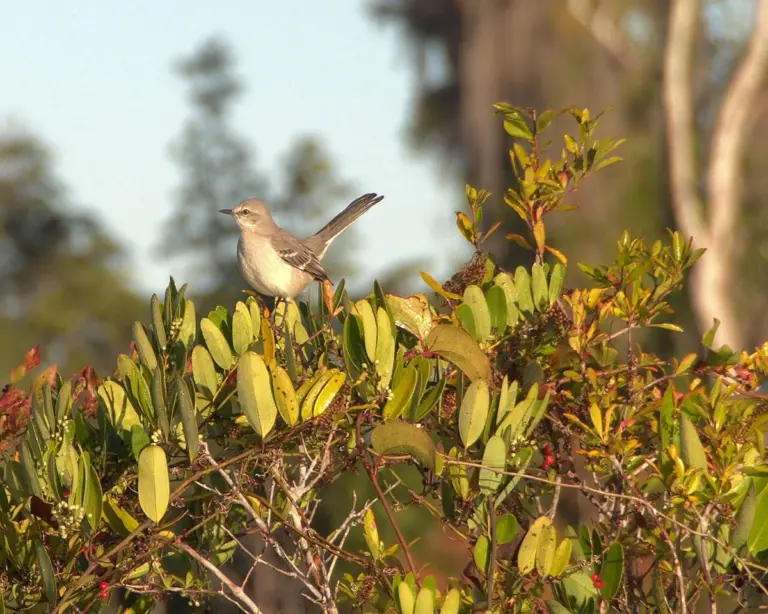
Mississippi · Northern Mockingbird
The northern mockingbird is a mockingbird commonly found in North America, of the family Mimidae. The species is also found in some parts of the Caribbean, as well as on the Hawaiian Islands. It is typically a permanent resident across much of its range, but northern mockingbirds may move farther south during inclement weather or prior to the onset of winter. The northern mockingbird has gray to brown upper feathers and a paler belly. Its tail and wings have white patches which are visible in flight.
A gray songbird famous for copying other birds' songs, and even car alarms; one male can know a couple hundred tunes. White wing patches flash when it flies.
State bird of Mississippi since 1944.
From Wikipedia: Northern mockingbird (CC BY-SA 4.0)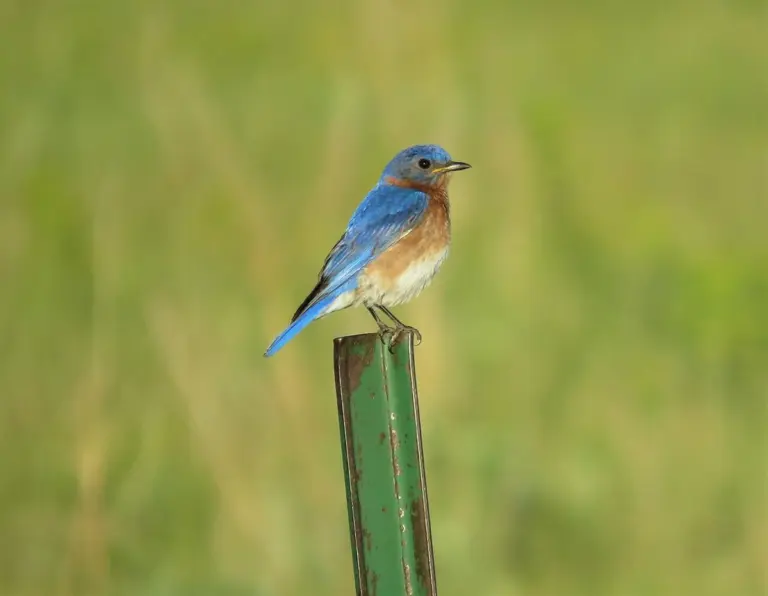
Missouri · Eastern Bluebird
The eastern bluebird is a small North American migratory thrush found in open woodlands, farmlands, and orchards.
A small thrush with a bright blue back and rusty breast. Nest-box trails helped it come back after it declined in the 1900s.
State bird of Missouri since 1927.
From Wikipedia: Eastern bluebird (CC BY-SA 4.0)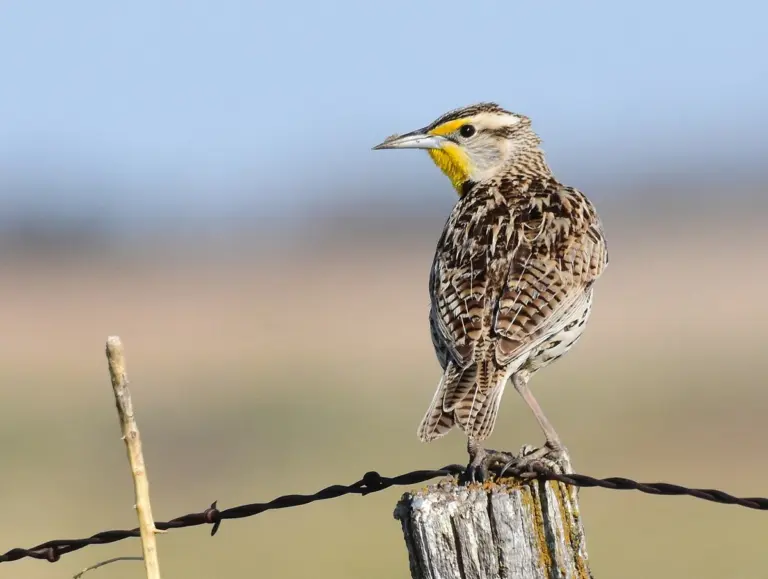
Montana · Western Meadowlark
The western meadowlark is a medium-sized icterid bird, about 20 cm (7.9 in) in length. It is found across western and central North America and is a partial migrant, breeding in western Canada and western United States west of the Great Lakes, and in northern Mexico. In the northern half of the breeding range, the birds migrate south for the winter, while further south they are resident all year. The winter range also extends south and southeast of the breeding range, as far as central Mexico, and east to western Florida. The western meadowlark nests on the ground in open grasslands and shrublands.
A chunky grassland bird with a yellow breast and a black V, often singing its flute-like song from a fence post.
State bird of Montana since 1941.
From Wikipedia: Western meadowlark (CC BY-SA 4.0)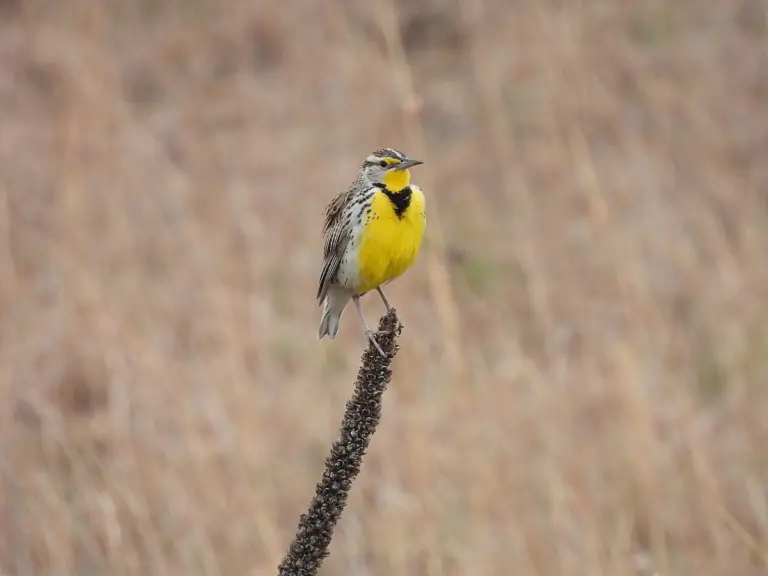
Nebraska · Western Meadowlark
The western meadowlark is a medium-sized icterid bird, about 20 cm (7.9 in) in length. It is found across western and central North America and is a partial migrant, breeding in western Canada and western United States west of the Great Lakes, and in northern Mexico. In the northern half of the breeding range, the birds migrate south for the winter, while further south they are resident all year. The winter range also extends south and southeast of the breeding range, as far as central Mexico, and east to western Florida. The western meadowlark nests on the ground in open grasslands and shrublands.
A chunky grassland bird with a yellow breast and a black V, often singing its flute-like song from a fence post.
State bird of Nebraska since 1929.
From Wikipedia: Western meadowlark (CC BY-SA 4.0)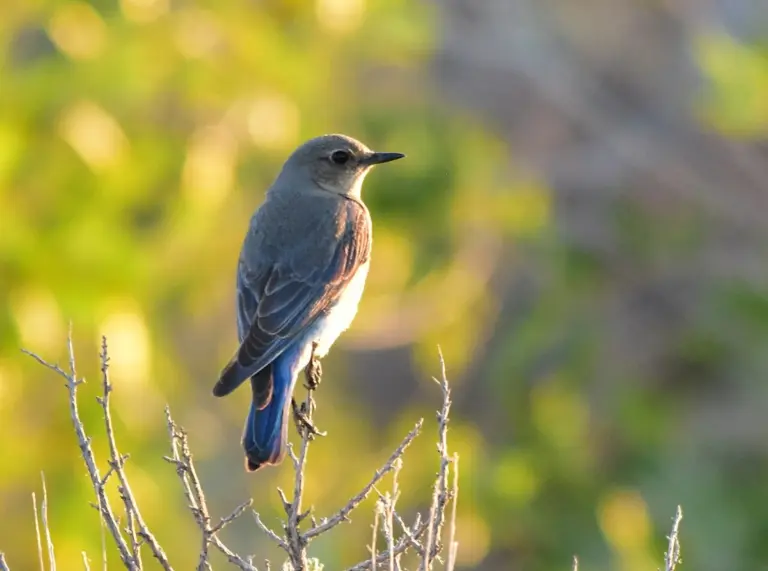
Nevada · Mountain Bluebird
The mountain bluebird is a migratory small thrush that is found in mountainous districts of western North America. It has a light underbelly and black eyes. Adult males have thin bills and are bright turquoise-blue and somewhat lighter underneath. Adult females have duller blue wings and tail, grey breast, grey crown, throat and back. In fresh fall plumage, the female's throat and breast are tinged with red-orange which is brownish near the flank, contrasting with white tail underparts.
Males are sky blue all over; females are gray with blue wings. It nests in tree holes and nest boxes in open mountain country.
State bird of Nevada since 1967.
From Wikipedia: Mountain bluebird (CC BY-SA 4.0)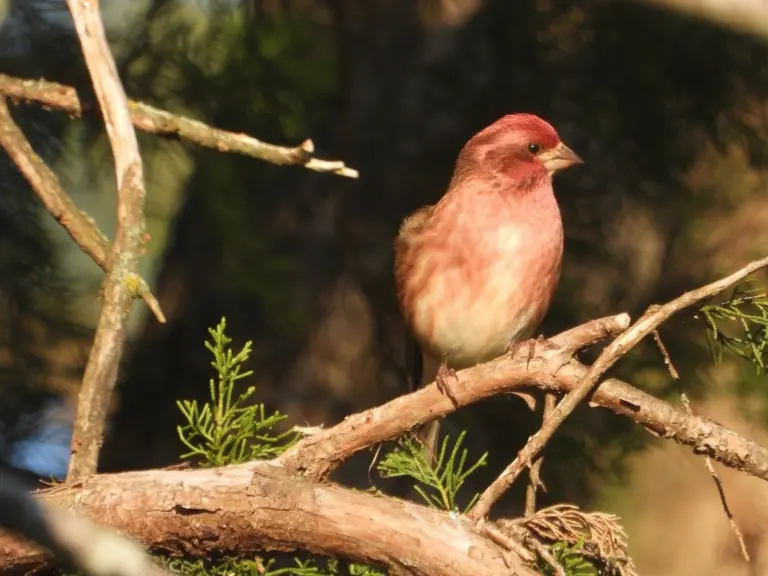
New Hampshire · Purple Finch
The purple finch is a bird in the finch family, Fringillidae. It breeds in the northern United States, southern Canada, and the west coast of North America.
Despite the name, the male is raspberry red, as if dipped in juice; females are brown and streaked. It visits feeders in northern forests.
State bird of New Hampshire since 1957.
From Wikipedia: Purple finch (CC BY-SA 4.0)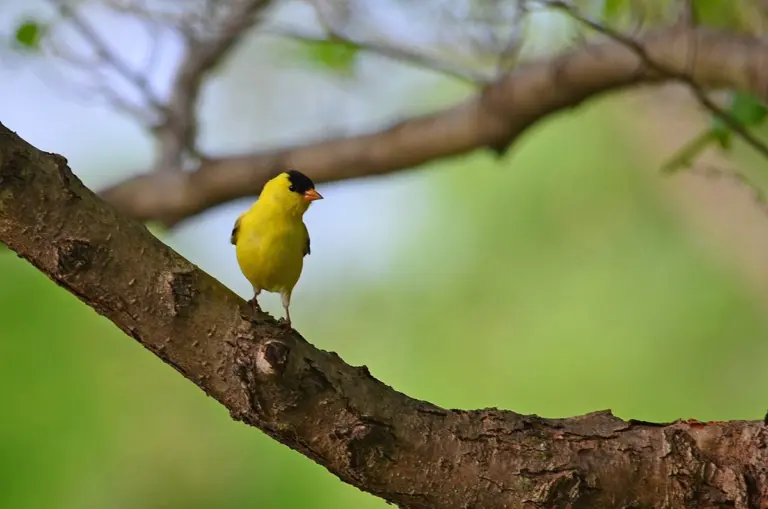
New Jersey · Eastern Goldfinch
The American goldfinch is a small North American bird in the finch family. It is migratory, ranging from mid-Alberta to North Carolina during the breeding season, and from just south of the Canada–United States border to Mexico during the winter.
In summer the male is lemon yellow with black wings and cap; in winter both turn olive-brown. Goldfinches nest late in summer, when thistle seed is ripe.
State bird of New Jersey since 1935.
From Wikipedia: American goldfinch (CC BY-SA 4.0)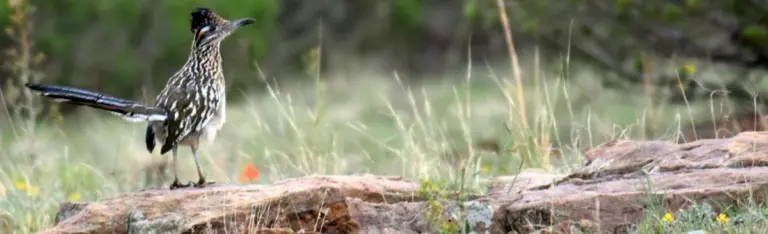
New Mexico · Greater Roadrunner
The greater roadrunner is a long-legged bird in the cuckoo family, Cuculidae, from the Aridoamerica region in the Southwestern United States and Mexico. The scientific name means "Californian earth-cuckoo". Along with the lesser roadrunner, it is one of two species in the genus Geococcyx. This roadrunner is also known as the chaparral cock, ground cuckoo, and snake killer.
A ground-running cousin of the cuckoo that can reach about 15 miles per hour and catches lizards, insects and even small snakes.
State bird of New Mexico since 1949.
From Wikipedia: Greater roadrunner (CC BY-SA 4.0)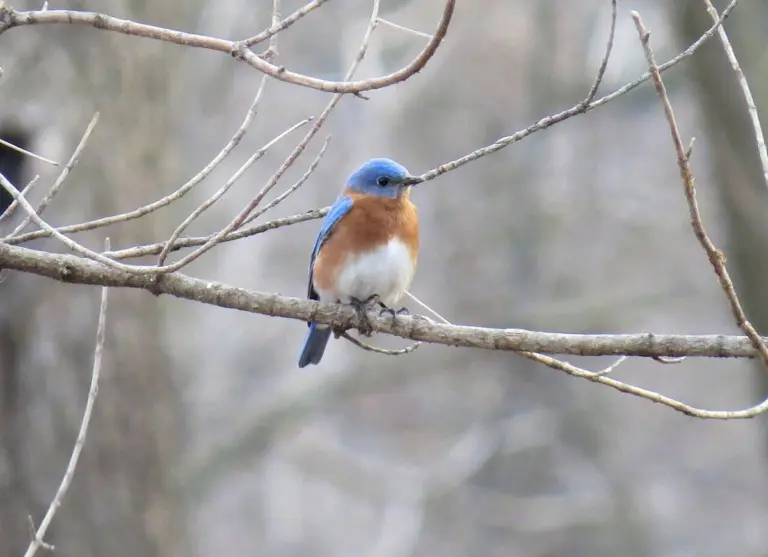
New York · Eastern Bluebird
The eastern bluebird is a small North American migratory thrush found in open woodlands, farmlands, and orchards.
A small thrush with a bright blue back and rusty breast. Nest-box trails helped it come back after it declined in the 1900s. New York was the last state to name its bird.
State bird of New York since 1970.
From Wikipedia: Eastern bluebird (CC BY-SA 4.0)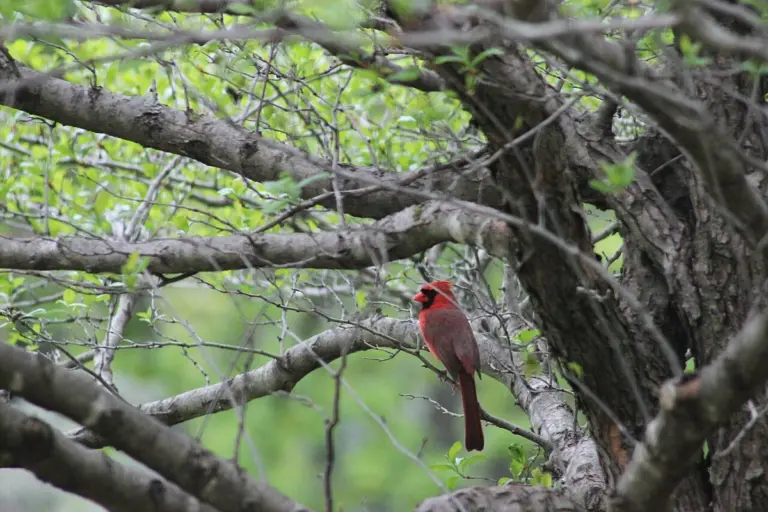
North Carolina · Northern Cardinal
The northern cardinal, also commonly known as the common cardinal, red cardinal, or simply cardinal, is a bird in the genus Cardinalis. It can be found in southeastern Canada, through the eastern United States from Maine to Minnesota to Texas, New Mexico, southern Arizona, southern California and south through Mexico, Belize, and Guatemala. It is also an introduced species in a few locations such as Bermuda and all major islands of Hawaii since its introduction in 1929. Its habitat includes woodlands, gardens, shrublands, and wetlands. It is the state bird of Illinois, Indiana, Kentucky, North Carolina, Ohio, Virginia, and West Virginia.
The bright red male with its black face and pointed crest is easy to spot, especially against snow. Cardinals stay all year and come readily to sunflower seed.
State bird of North Carolina since 1943.
From Wikipedia: Northern cardinal (CC BY-SA 4.0)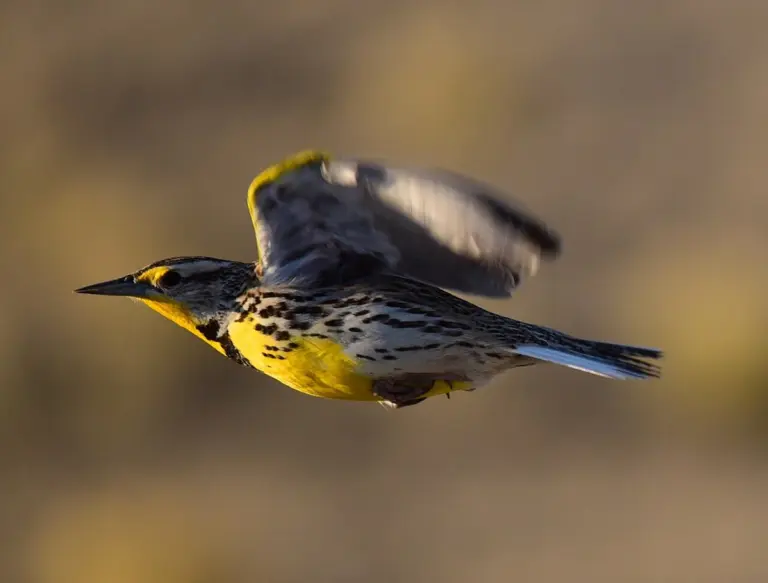
North Dakota · Western Meadowlark
The western meadowlark is a medium-sized icterid bird, about 20 cm (7.9 in) in length. It is found across western and central North America and is a partial migrant, breeding in western Canada and western United States west of the Great Lakes, and in northern Mexico. In the northern half of the breeding range, the birds migrate south for the winter, while further south they are resident all year. The winter range also extends south and southeast of the breeding range, as far as central Mexico, and east to western Florida. The western meadowlark nests on the ground in open grasslands and shrublands.
A chunky grassland bird with a yellow breast and a black V, often singing its flute-like song from a fence post.
State bird of North Dakota since 1947.
From Wikipedia: Western meadowlark (CC BY-SA 4.0)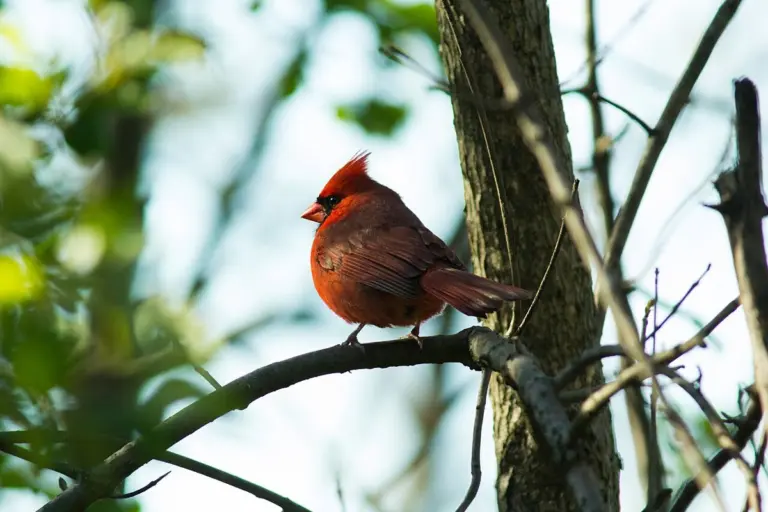
Ohio · Northern Cardinal
The northern cardinal, also commonly known as the common cardinal, red cardinal, or simply cardinal, is a bird in the genus Cardinalis. It can be found in southeastern Canada, through the eastern United States from Maine to Minnesota to Texas, New Mexico, southern Arizona, southern California and south through Mexico, Belize, and Guatemala. It is also an introduced species in a few locations such as Bermuda and all major islands of Hawaii since its introduction in 1929. Its habitat includes woodlands, gardens, shrublands, and wetlands. It is the state bird of Illinois, Indiana, Kentucky, North Carolina, Ohio, Virginia, and West Virginia.
The bright red male with its black face and pointed crest is easy to spot, especially against snow. Cardinals stay all year and come readily to sunflower seed.
State bird of Ohio since 1933.
From Wikipedia: Northern cardinal (CC BY-SA 4.0)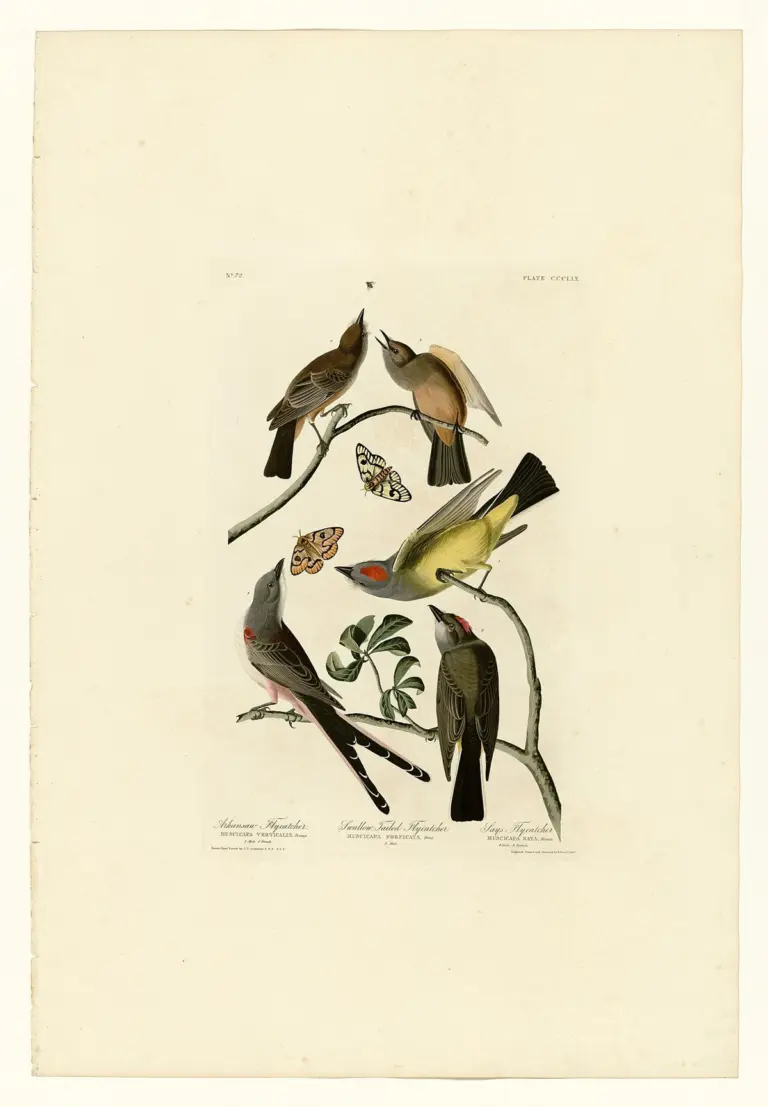
Oklahoma · Scissor-tailed Flycatcher
The scissor-tailed flycatcher, known as swallow-tailed flycatcher or scissorstail, is a long-tailed insectivorous bird of the genus Tyrannus, whose members are collectively referred to as kingbirds. It is found in North and Central America, and is Oklahoma's State Bird.
A pale gray flycatcher with salmon-pink sides and a very long, forked tail it opens like scissors in flight. (Picture: Audubon's "Swallow-tailed Flycatcher", the middle bird.)
State bird of Oklahoma since 1951.
From Wikipedia: Scissor-tailed flycatcher (CC BY-SA 4.0)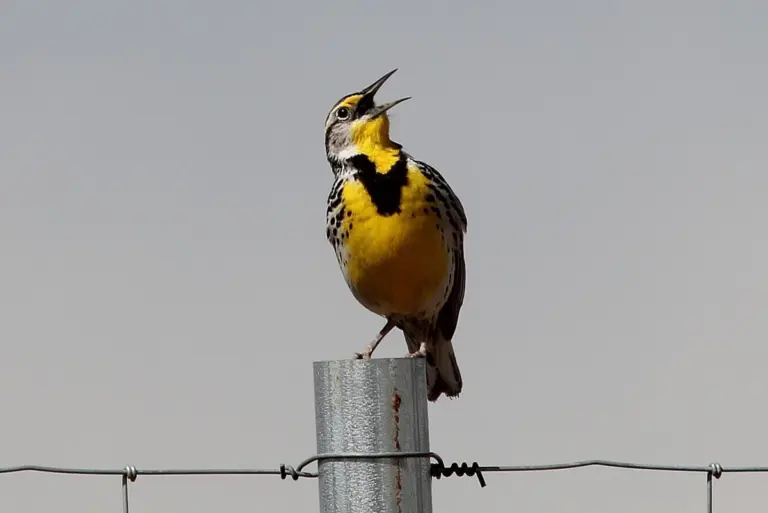
Oregon · Western Meadowlark
The western meadowlark is a medium-sized icterid bird, about 20 cm (7.9 in) in length. It is found across western and central North America and is a partial migrant, breeding in western Canada and western United States west of the Great Lakes, and in northern Mexico. In the northern half of the breeding range, the birds migrate south for the winter, while further south they are resident all year. The winter range also extends south and southeast of the breeding range, as far as central Mexico, and east to western Florida. The western meadowlark nests on the ground in open grasslands and shrublands.
A chunky grassland bird with a yellow breast and a black V, often singing its flute-like song from a fence post.
State bird of Oregon since 1927.
From Wikipedia: Western meadowlark (CC BY-SA 4.0)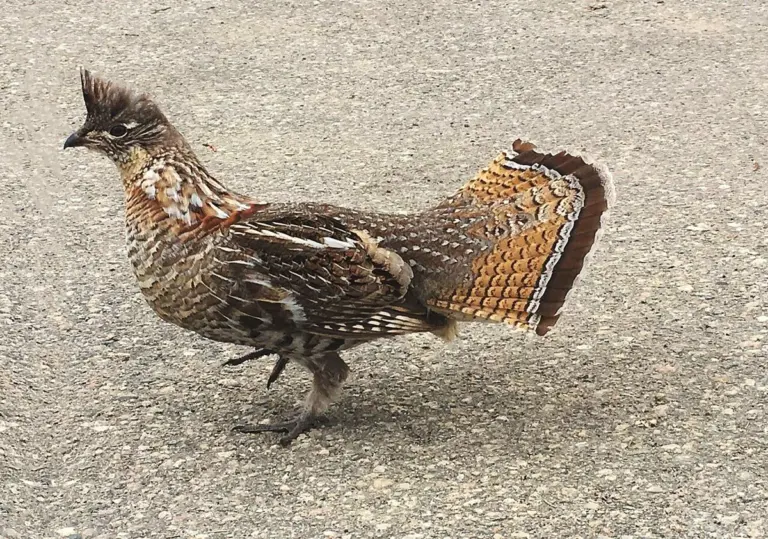
Pennsylvania · Ruffed Grouse
The ruffed grouse is a medium-sized grouse occurring in forests from the Appalachian Mountains across Canada to Alaska. It is the most widely distributed game bird in North America. It is not migratory. It is the only species in the genus Bonasa. The ruffed grouse is sometimes incorrectly referred to as a "partridge", an unrelated phasianid, and occasionally confused with the grey partridge, a bird of open areas rather than woodlands.
Pennsylvania never chose an official state bird; the ruffed grouse is its state game bird. In spring the male drums by beating his wings, a sound like a far-off engine starting.
State bird of Pennsylvania since 1931.
From Wikipedia: Ruffed grouse (CC BY-SA 4.0)Rhode Island · Rhode Island Red chicken
The Rhode Island Red is an American breed of domestic chicken. It is the state bird of Rhode Island. It was developed there and in Massachusetts in the late nineteenth century, by cross-breeding birds of Oriental origin such as the Malay with brown Leghorn birds from Italy. It was a dual-purpose breed, raised both for meat and for eggs; modern strains have been bred for their egg-laying abilities. The traditional non-industrial strains of the Rhode Island Red are listed as "watch" by The Livestock Conservancy.
A chicken breed developed in Rhode Island in the 1800s, known for deep red-brown feathers and good egg laying. A monument in Adamsville honors it.
State bird of Rhode Island since 1954.
From Wikipedia: Rhode Island Red (CC BY-SA 4.0)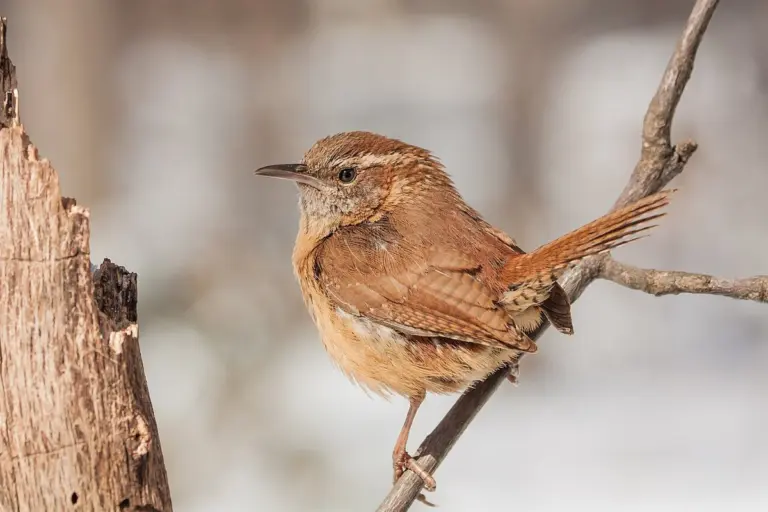
South Carolina · Carolina Wren
The Carolina wren is a species of wren common in the eastern United States, the extreme south of Ontario, Canada, the northeast and southeast of Mexico, and into northern Central America. Severe winters restrict the northern limits of their range, while favorable weather conditions lead to a northward extension of their breeding range. Their preferred habitat is in dense cover in forest, farm edges, and suburban areas. This wren is the state bird of South Carolina.
A small, loud, rusty-brown wren with a white eyebrow. Its ringing teakettle-teakettle-teakettle song can be heard all year.
State bird of South Carolina since 1948.
From Wikipedia: Carolina wren (CC BY-SA 4.0)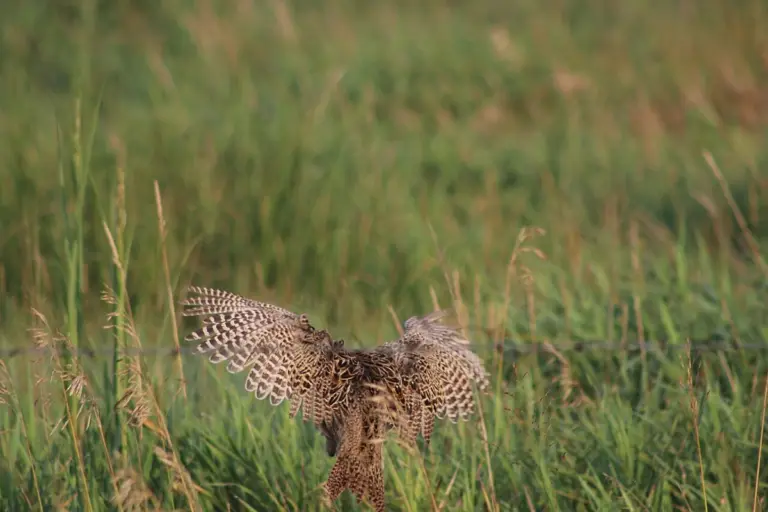
South Dakota · Ring-necked Pheasant
The common pheasant, ring-necked pheasant, or blue-headed pheasant, is a bird in the pheasant family (Phasianidae). The genus name comes from Latin phasianus 'pheasant'. The species name colchicus is Latin for 'of Colchis', a country on the Black Sea where pheasants became known to Europeans. Although Phasianus was previously thought to be closely related to the genus Gallus, the genus of junglefowl and domesticated chickens, recent studies show that they are in different subfamilies, having diverged over 20 million years ago.
Brought over from Asia, the pheasant is now South Dakota's best-known game bird. Males have a green head, a red face patch and a white neck ring.
State bird of South Dakota since 1943.
From Wikipedia: Common pheasant (CC BY-SA 4.0)
Tennessee · Northern Mockingbird
The northern mockingbird is a mockingbird commonly found in North America, of the family Mimidae. The species is also found in some parts of the Caribbean, as well as on the Hawaiian Islands. It is typically a permanent resident across much of its range, but northern mockingbirds may move farther south during inclement weather or prior to the onset of winter. The northern mockingbird has gray to brown upper feathers and a paler belly. Its tail and wings have white patches which are visible in flight.
A gray songbird famous for copying other birds' songs, and even car alarms; one male can know a couple hundred tunes. White wing patches flash when it flies.
State bird of Tennessee since 1933.
From Wikipedia: Northern mockingbird (CC BY-SA 4.0)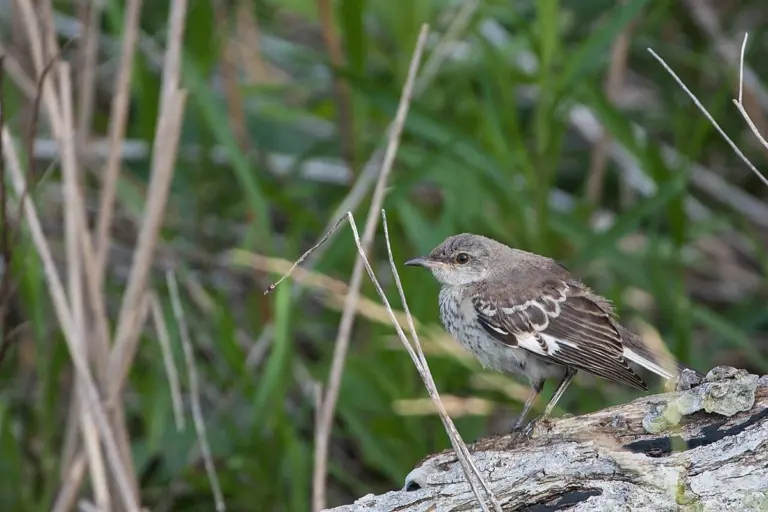
Texas · Northern Mockingbird
The northern mockingbird is a mockingbird commonly found in North America, of the family Mimidae. The species is also found in some parts of the Caribbean, as well as on the Hawaiian Islands. It is typically a permanent resident across much of its range, but northern mockingbirds may move farther south during inclement weather or prior to the onset of winter. The northern mockingbird has gray to brown upper feathers and a paler belly. Its tail and wings have white patches which are visible in flight.
A gray songbird famous for copying other birds' songs, and even car alarms; one male can know a couple hundred tunes. White wing patches flash when it flies.
State bird of Texas since 1927.
From Wikipedia: Northern mockingbird (CC BY-SA 4.0)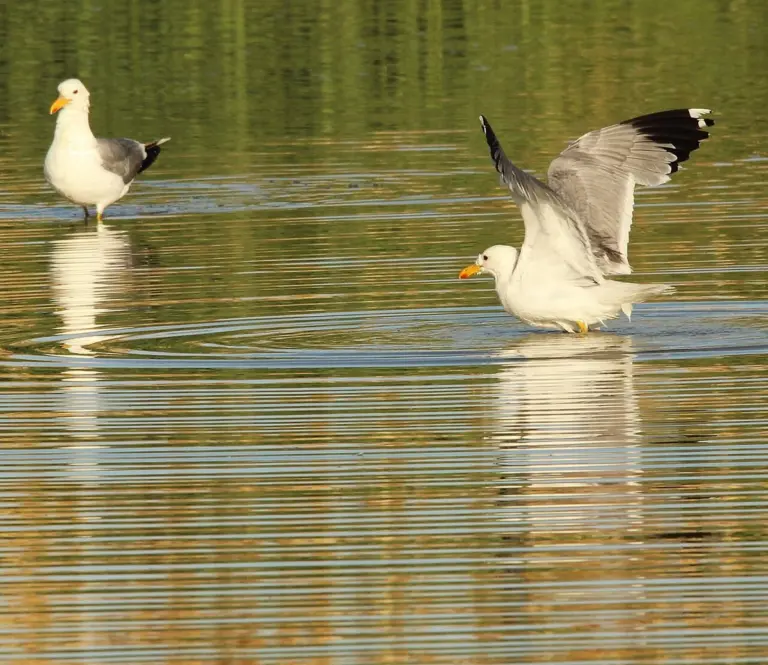
Utah · California Gull
The California gull is a medium-sized gull, smaller on average than the herring gull, but larger on average than the ring-billed gull. Although named after California, it can be found annually across most of western North America, from the Canadian prairie provinces in the northeast and south through western Mexico.
Utah honors the gulls said to have saved pioneer crops from a plague of crickets in 1848. A large colony nests on the Great Salt Lake.
State bird of Utah since 1955.
From Wikipedia: California gull (CC BY-SA 4.0)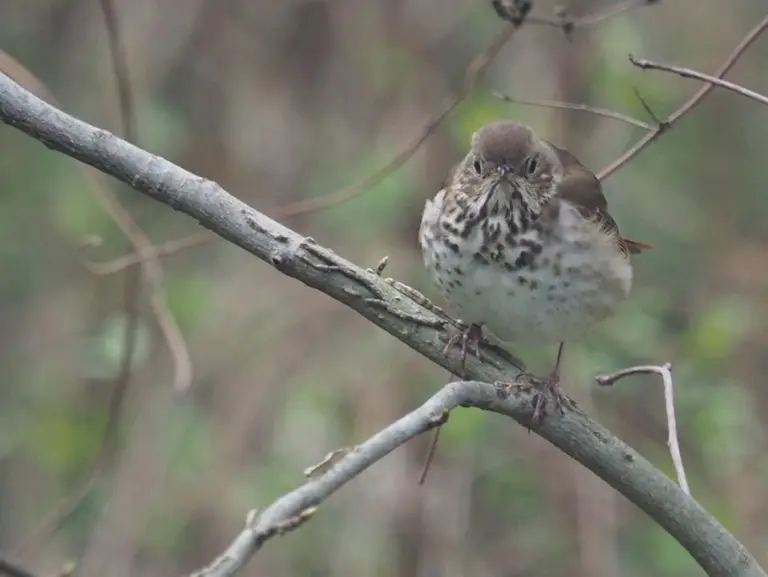
Vermont · Hermit Thrush
The hermit thrush is a medium-sized North American thrush.
A shy brown thrush of the forest floor with a reddish tail. Its flute-like evening song is often called the most beautiful in North America.
State bird of Vermont since 1941.
From Wikipedia: Hermit thrush (CC BY-SA 4.0)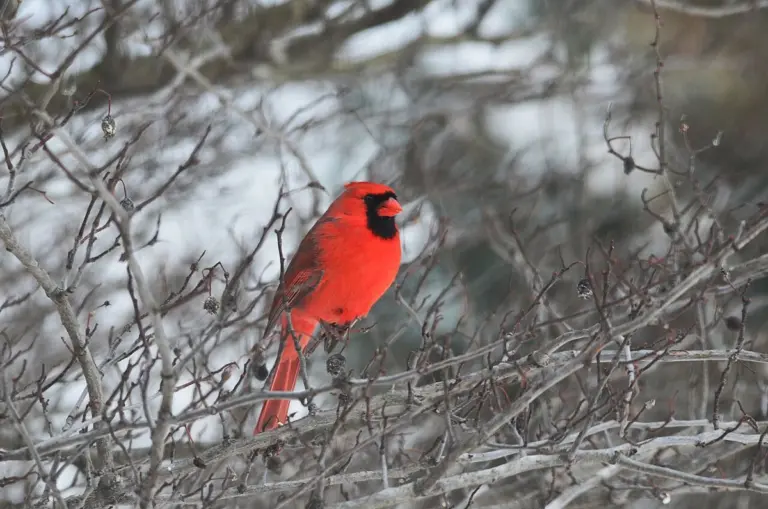
Virginia · Northern Cardinal
The northern cardinal, also commonly known as the common cardinal, red cardinal, or simply cardinal, is a bird in the genus Cardinalis. It can be found in southeastern Canada, through the eastern United States from Maine to Minnesota to Texas, New Mexico, southern Arizona, southern California and south through Mexico, Belize, and Guatemala. It is also an introduced species in a few locations such as Bermuda and all major islands of Hawaii since its introduction in 1929. Its habitat includes woodlands, gardens, shrublands, and wetlands. It is the state bird of Illinois, Indiana, Kentucky, North Carolina, Ohio, Virginia, and West Virginia.
The bright red male with its black face and pointed crest is easy to spot, especially against snow. Cardinals stay all year and come readily to sunflower seed.
State bird of Virginia since 1950.
From Wikipedia: Northern cardinal (CC BY-SA 4.0)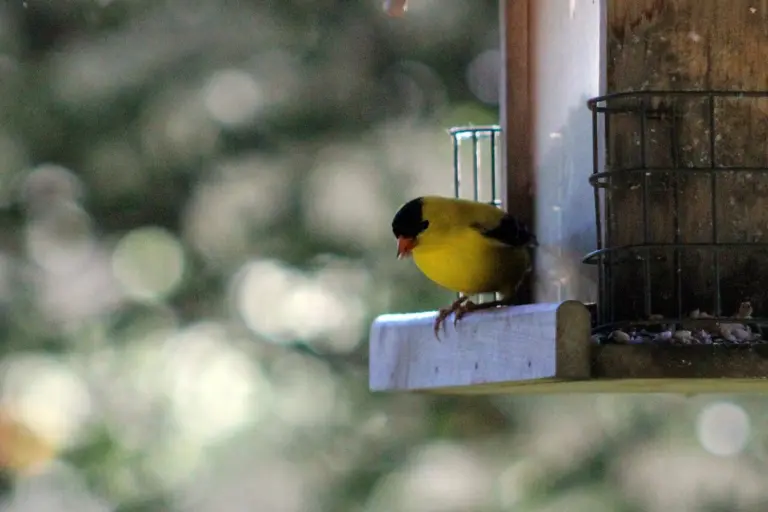
Washington · Willow Goldfinch
The American goldfinch is a small North American bird in the finch family. It is migratory, ranging from mid-Alberta to North Carolina during the breeding season, and from just south of the Canada–United States border to Mexico during the winter.
In summer the male is lemon yellow with black wings and cap; in winter both turn olive-brown. Goldfinches nest late in summer, when thistle seed is ripe.
State bird of Washington since 1951.
From Wikipedia: American goldfinch (CC BY-SA 4.0)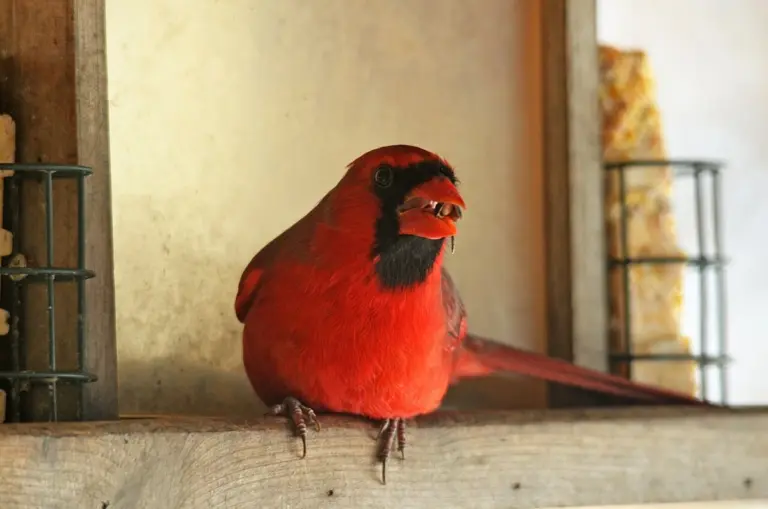
West Virginia · Northern Cardinal
The northern cardinal, also commonly known as the common cardinal, red cardinal, or simply cardinal, is a bird in the genus Cardinalis. It can be found in southeastern Canada, through the eastern United States from Maine to Minnesota to Texas, New Mexico, southern Arizona, southern California and south through Mexico, Belize, and Guatemala. It is also an introduced species in a few locations such as Bermuda and all major islands of Hawaii since its introduction in 1929. Its habitat includes woodlands, gardens, shrublands, and wetlands. It is the state bird of Illinois, Indiana, Kentucky, North Carolina, Ohio, Virginia, and West Virginia.
The bright red male with its black face and pointed crest is easy to spot, especially against snow. Cardinals stay all year and come readily to sunflower seed.
State bird of West Virginia since 1949.
From Wikipedia: Northern cardinal (CC BY-SA 4.0)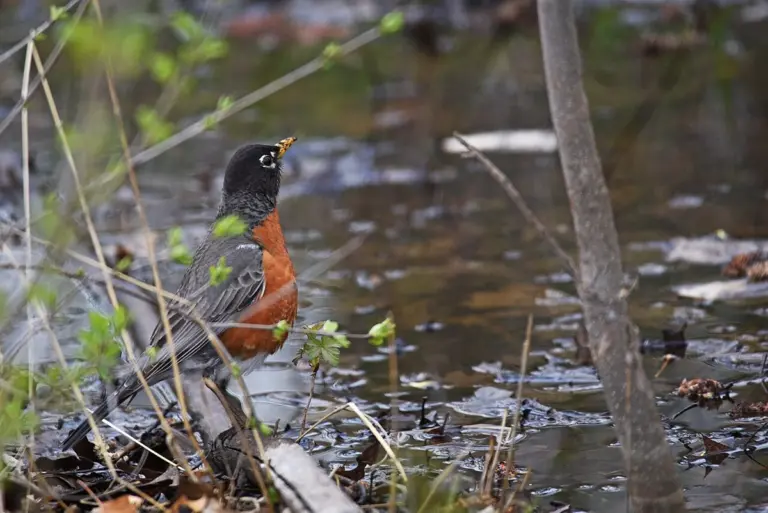
Wisconsin · American Robin
The American robin is a migratory bird of the true thrush genus and Turdidae, the wider thrush family. It is named after the European robin because of its reddish-orange breast, though the two species are not closely related, with the European robin belonging to the Old World flycatcher family. The American robin is widely distributed throughout North America, wintering from southern Canada to central Mexico and along the Pacific coast.
One of the most familiar backyard birds, with a brick-red breast, often seen tugging earthworms from a lawn. Its cheerful caroling is a sure sign of spring.
State bird of Wisconsin since 1949.
From Wikipedia: American robin (CC BY-SA 4.0)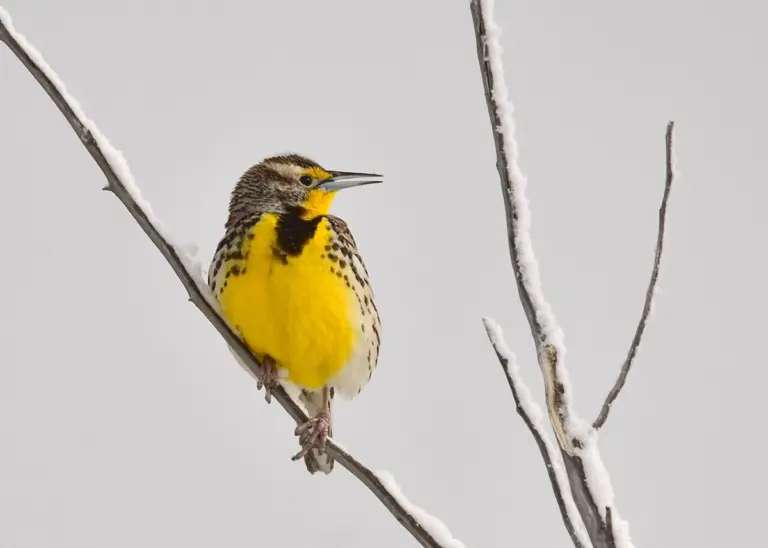
Wyoming · Western Meadowlark
The western meadowlark is a medium-sized icterid bird, about 20 cm (7.9 in) in length. It is found across western and central North America and is a partial migrant, breeding in western Canada and western United States west of the Great Lakes, and in northern Mexico. In the northern half of the breeding range, the birds migrate south for the winter, while further south they are resident all year. The winter range also extends south and southeast of the breeding range, as far as central Mexico, and east to western Florida. The western meadowlark nests on the ground in open grasslands and shrublands.
A chunky grassland bird with a yellow breast and a black V, often singing its flute-like song from a fence post.
State bird of Wyoming since 1927.
From Wikipedia: Western meadowlark (CC BY-SA 4.0)
Delaware (the Blue Hen) and Rhode Island (the Rhode Island Red) chose chicken breeds, and we could not find public-domain pictures of them yet. If you have a photo you would like to share, we would love to see it.
Picture credits
All pictures are in the public domain: photos by U.S. federal agencies (such as the U.S. Fish & Wildlife Service, National Park Service and USDA) and vintage illustrations whose copyright has expired. Click a card to see the picture larger and read more. The short descriptions under each picture are from Wikipedia (CC BY-SA 4.0), linked on each card. Years are when each state adopted its symbol, from Wikipedia’s cited lists of state birds and state flowers; some states chose a symbol earlier and made it law later.
- Alabama (Yellowhammer): U.S. government photo, public domain · source
- Alaska (Willow Ptarmigan): U.S. government photo, public domain · source
- Arizona (Cactus Wren): U.S. government photo, public domain · source
- Arkansas (Northern Mockingbird): U.S. government photo, public domain · source
- California (California Quail): U.S. government photo, public domain · source
- Colorado (Lark Bunting): Vintage illustration, public domain · source
- Connecticut (American Robin): U.S. government photo, public domain · source
- Florida (Northern Mockingbird): U.S. government photo, public domain · source
- Georgia (Brown Thrasher): U.S. government photo, public domain · source
- Hawaii (Nene (Hawaiian goose)): U.S. government photo, public domain · source
- Idaho (Mountain Bluebird): U.S. government photo, public domain · source
- Illinois (Northern Cardinal): U.S. government photo, public domain · source
- Indiana (Northern Cardinal): U.S. government photo, public domain · source
- Iowa (Eastern Goldfinch): U.S. government photo, public domain · source
- Kansas (Western Meadowlark): U.S. government photo, public domain · source
- Kentucky (Northern Cardinal): U.S. government photo, public domain · source
- Louisiana (Brown Pelican): U.S. government photo, public domain · source
- Maine (Black-capped Chickadee): U.S. government photo, public domain · source
- Maryland (Baltimore Oriole): U.S. government photo, public domain · source
- Massachusetts (Black-capped Chickadee): U.S. government photo, public domain · source
- Michigan (American Robin): U.S. government photo, public domain · source
- Minnesota (Common Loon): U.S. government photo, public domain · source
- Mississippi (Northern Mockingbird): U.S. government photo, public domain · source
- Missouri (Eastern Bluebird): U.S. government photo, public domain · source
- Montana (Western Meadowlark): U.S. government photo, public domain · source
- Nebraska (Western Meadowlark): U.S. government photo, public domain · source
- Nevada (Mountain Bluebird): U.S. government photo, public domain · source
- New Hampshire (Purple Finch): U.S. government photo, public domain · source
- New Jersey (Eastern Goldfinch): U.S. government photo, public domain · source
- New Mexico (Greater Roadrunner): U.S. government photo, public domain · source
- New York (Eastern Bluebird): U.S. government photo, public domain · source
- North Carolina (Northern Cardinal): U.S. government photo, public domain · source
- North Dakota (Western Meadowlark): U.S. government photo, public domain · source
- Ohio (Northern Cardinal): U.S. government photo, public domain · source
- Oklahoma (Scissor-tailed Flycatcher): Vintage illustration, public domain · source
- Oregon (Western Meadowlark): U.S. government photo, public domain · source
- Pennsylvania (Ruffed Grouse): U.S. government photo, public domain · source
- South Carolina (Carolina Wren): U.S. government photo, public domain · source
- South Dakota (Ring-necked Pheasant): U.S. government photo, public domain · source
- Tennessee (Northern Mockingbird): U.S. government photo, public domain · source
- Texas (Northern Mockingbird): U.S. government photo, public domain · source
- Utah (California Gull): U.S. government photo, public domain · source
- Vermont (Hermit Thrush): U.S. government photo, public domain · source
- Virginia (Northern Cardinal): U.S. government photo, public domain · source
- Washington (Willow Goldfinch): U.S. government photo, public domain · source
- West Virginia (Northern Cardinal): U.S. government photo, public domain · source
- Wisconsin (American Robin): U.S. government photo, public domain · source
- Wyoming (Western Meadowlark): U.S. government photo, public domain · source


