Vintage Dessert
This apple crisp pie comes from a 1958 Armour Star Lard ad. Marie Gifford, whom the ad calls “Armour’s Home Economist and pastry authority,” shared her quick lard crust with a crumb-topped apple filling under a lattice top. Here is the recipe as it was printed, followed by directions for making it today.
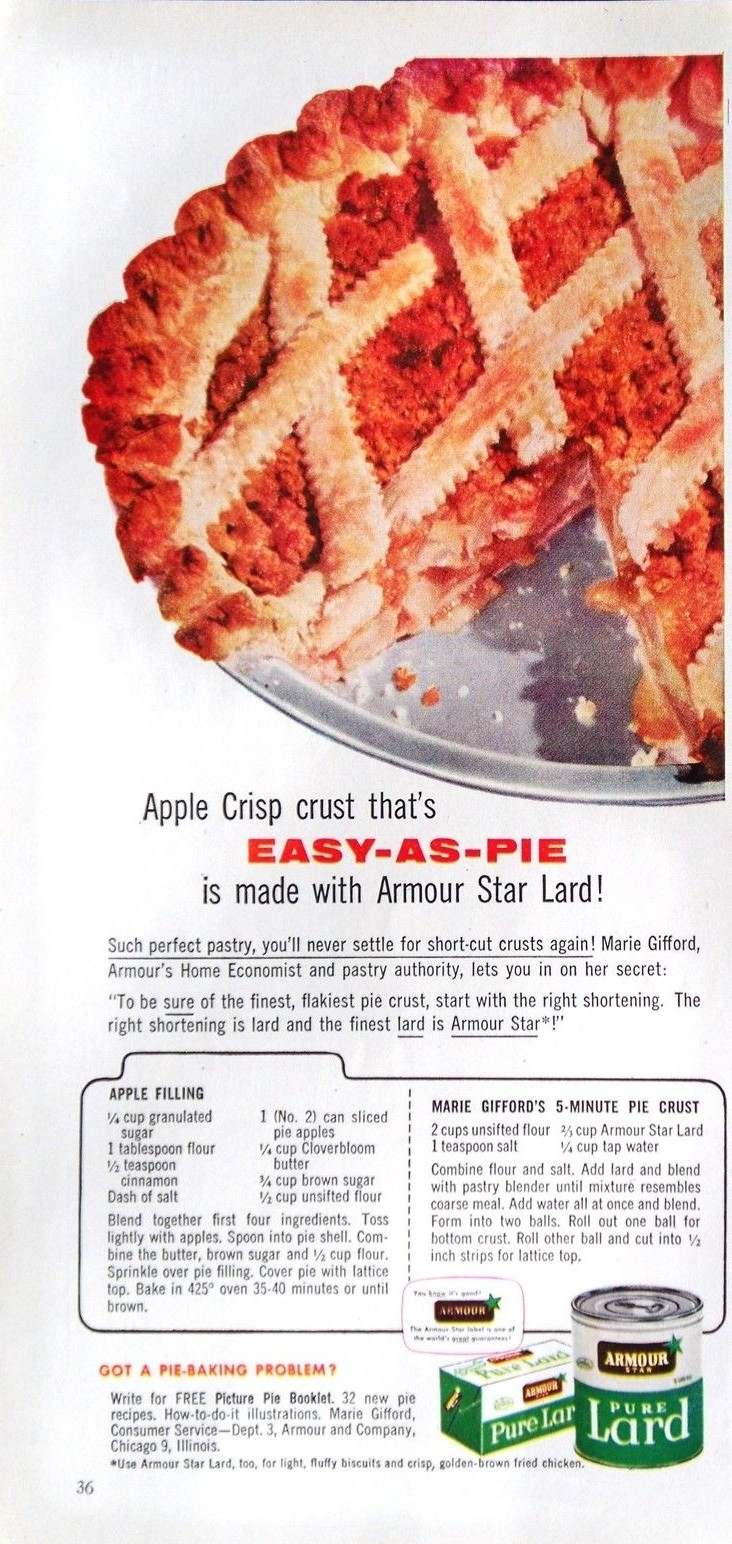
How it goes together: the ad prints the filling first, but you make the crust first. Line the pie plate with crust, add the apples tossed with sugar, flour, cinnamon, and salt, sprinkle the crisp topping (butter, brown sugar, and flour) over the apples, then lay the lattice on top. The step-by-step Modern Directions are below the recipe cards.
Apple Filling and Crisp Topping
Ingredients
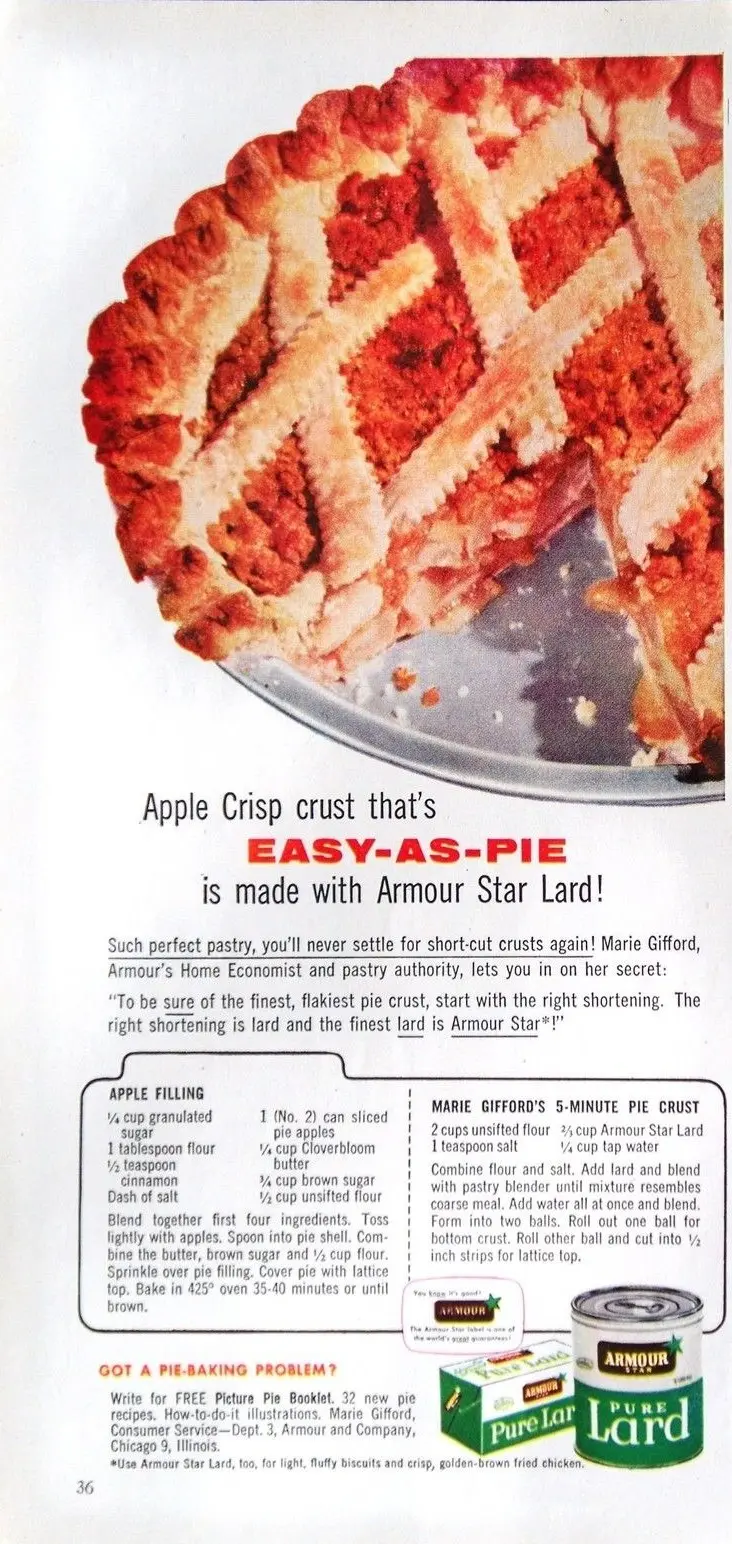
- 1/4 cup granulated sugar
- 1 tablespoon flour
- 1/2 teaspoon cinnamon
- Dash of Salt
- 1 (No. 2) can sliced pie apples
- 1/4 cup butter
- 3/4 cup brown sugar
- 1/2 cup unsifted flour
Directions
- Blend together first four ingredients. Toss lightly with apples. Spoon into pie shell. Combine the butter, brown sugar and 1/2 cup flour. Sprinkle over pie filling. Cover pie with lattice top. Bake in 425 degree F. oven 35-40 minutes or until brown.
Ingredients
- 2 cups unsifted flour
- 1 teaspoon salt
- 2/3 cup lard
- 1/4 cup tap water
Directions
- Combine flour and salt. Add lard and blend with pastry blender until mixture resembles coarse meal. Add water all at once and blend. Form into two balls. Roll out one ball for bottom crust. Roll other ball and cut into 1/2-inch strips for lattice top.
Modern Directions
The 1958 recipe assumes you already know how to make a pie. These steps fill in the gaps for today's kitchen. A No. 2 can, the size the ad calls for, holds about 2 1/2 cups.
- Make the crust. Stir together 2 cups flour and 1 teaspoon salt. Cut in 2/3 cup cold lard with a pastry blender until the mixture looks like coarse meal. Add 1/4 cup ice water all at once and stir just until the dough holds together. If it's too dry to gather, add a little more water, a teaspoon at a time.
- Chill the dough. Form two balls, flatten each into a disk, wrap, and refrigerate for 30 minutes. Cold dough rolls out more easily and bakes up flakier.
- Heat the oven to 425°F. Roll out one disk and fit it into a 9-inch pie plate.
- Make the filling. Use a 20-ounce can of sliced apples (not pie filling), drained, or about 3 medium apples, peeled, cored, and thinly sliced. Mix 1/4 cup granulated sugar, 1 tablespoon flour, 1/2 teaspoon cinnamon, and a dash of salt. Toss gently with the apples and spoon them into the crust.
- Add the crumb topping. Mix 1/4 cup softened butter, 3/4 cup brown sugar, and 1/2 cup flour with a fork until crumbly. Sprinkle it over the apples.
- Top with a lattice. Roll out the second disk and cut it into 1/2-inch strips. Lay them over the pie in a crisscross, trim the ends, and crimp the edges.
- Bake for 35 to 40 minutes, until the crust is golden brown and fresh apples are tender when you poke one through the lattice. If the edges brown too fast, cover them with strips of foil. Let the pie cool before slicing.
A Note About Lard
The lard in most supermarkets today is hydrogenated to keep it shelf-stable, and many brands add a preservative such as BHT. It works more like vegetable shortening, and it won't give you the tender, flaky crust this recipe promises. For the crust Marie Gifford had in mind, look for unhydrogenated leaf lard, the mild fat from around a pig's kidneys. Ask a local butcher, or order rendered leaf lard online. Check the label for the word “hydrogenated” before you buy.
Two Modern Tweaks
Half butter, half lard. Butter adds rich flavor, and lard keeps the crust flaky, so many bakers use equal amounts of each. The easy swap is 1/3 cup of each in place of the 2/3 cup lard. For a roomier double crust that's easier to roll and crimp, use this blend:
- 2 1/2 cups all-purpose flour
- 1 teaspoon salt
- 1/2 cup (1 stick) cold unsalted butter, cut in 1/2-inch cubes
- 1/2 cup cold leaf lard, cut in 1/2-inch cubes
- 6 to 8 tablespoons ice water
Put the cubed butter and lard in the freezer for 15 to 20 minutes. Whisk the flour and salt, then cut in the fats until the mixture looks like coarse crumbs with some pea-size pieces left. Those little pieces of fat make the flaky layers. Sprinkle in the ice water a tablespoon at a time, tossing with a fork, until the dough holds together when you pinch it. Divide it in two, flatten into disks, wrap, and chill for 30 to 60 minutes before rolling.
Use a food processor. Marie Gifford's crust was quick because you worked it fast by hand, before the fat could soften. A food processor does the same job in seconds. Pulse the flour and salt, add the cold fat, and pulse until it looks like coarse crumbs. Add the ice water and pulse just until the dough starts to clump. Stop there, since overworking makes a tough crust.